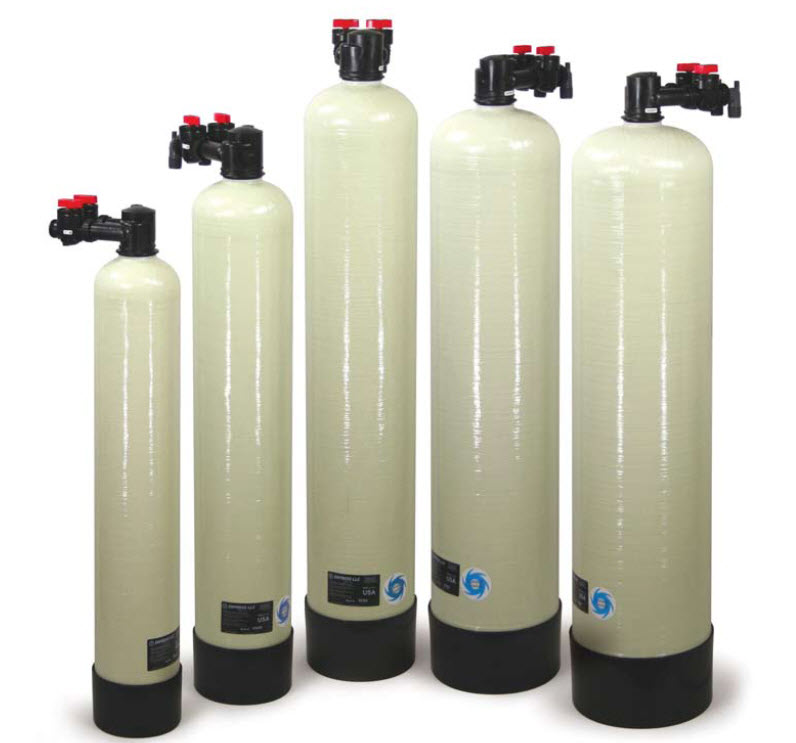
Enpress Vortech Tanks for use with Filtersorb filter media
Water softeners can be crucial components in a whole-house well water filtration system or any comprehensive water treatment solution. Suppose you’ve experienced scale buildup and clogging of pipes and fixtures. In that case, your water is likely too high in magnesium and/or calcium content—these are dissolved minerals known as hardness minerals, which are responsible for water hardness and its harmful effects on appliances, toilets, dishes, surfaces, and even your skin.
In other words, your water is too hard. Water with 1 or more grains per gallon (gpg) of these minerals is considered hard, which is another thing to worry about beyond other contaminants or chemicals in your water. A water softener will solve this problem fairly easily, but what softener will you use?
When choosing a water softener, you’ll need to decide between a traditional ion exchange system and a salt-free conditioner. Salt-free systems don’t remove hardness minerals but change their form to prevent scale. Both options work well, depending on your needs, but salt-free systems offer some unique benefits.
City and municipal water is usually treated for health risks like chlorine, but it may still contain hardness minerals, iron, and other contaminants that affect your home.
Normal water softeners, also known as traditional water softeners or salt-based water softeners, use a process called ion exchange to remove hardness. An ion-exchange resin inside the softener attracts calcium and magnesium from the water and replaces them with sodium ions from the exchange resin. During regeneration (the process by which the softener’s resin is cleaned and kept ready for use), saltwater is drawn from a brine tank into the softener to regenerate the sodium in the resin.
These systems remove calcium and magnesium, thereby reducing scale and hardness deposits. However, they require some light maintenance and increase the sodium content of water, which may affect drinking water and tap water quality.
Salt-free water conditioners use a catalytic process to turn calcium and magnesium into tiny calcite crystals. These crystals can’t stick to surfaces, so they flow through your system without forming scale. While they don’t remove hardness minerals, they change their form to prevent buildup on pipes, appliances, and fixtures. Over time, this also helps reduce existing deposits.
These systems need little maintenance. They don’t use electricity, don’t create wastewater, and don’t require backwashing or regeneration. This means lower water and energy use, no brine replacement, and more savings. They’re also easy to install, eco-friendly, and simple to maintain.
You can easily replace a standard softener with a salt-free conditioner. While it won’t remove hardness minerals, it changes them to a crystal form that won’t stick to surfaces. Your water won’t feel as slippery, but it will taste and feel better thanks to lower sodium levels.
Salt-free systems also help reduce chlorine taste and odor, especially in city water, giving you cleaner, fresher water throughout your home.
The Scale Stopper Conditioner is a salt-free water softener that helps protect your appliances, skin, hair, and home from hardness minerals, iron, and chemicals. It conditions your water without salt, improving your showers with softer hair and reduced dryness. You’ll also see fewer stains and less scale buildup on dishes, toilets, and surfaces.
Each system includes a carbon whole-house filter with a Vortech tank. It treats water with up to 50 grains per gallon of hardness, comes in five sizes, and is NSF-61 certified. Best of all, it doesn’t add sodium or harsh chemicals to your drinking water.
Before choosing any water system or water treatment solution, it’s important to schedule a professional water test to assess your water quality and determine the presence of contaminants, hardness minerals, iron, or other issues. This will help you select the most suitable system for your needs.
Resources:
If your tap water has started smelling or tasting a little "off" this week: earthy,…
If your water pressure has been weaker than usual this month, you're not imagining it.…
Is Your City Testing for This? Every year, your water utility sends out a report.…
Article last updated July 2026 If your well water is acidic, with a pH below…
Most homeowners come to us knowing something is wrong with their water. The smell, the…
If you are on city water and dealing with chlorine taste and odor, chemical smell…