Installing Water Treatment Systems

A Basic Guide on How Scale Stopper Works and Why

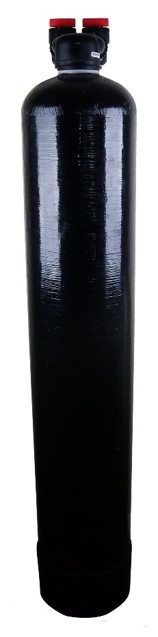
Scale Stopper (front)

How does the Scale Stopper work?

The Scale Stopper product relies on a technology called Template Assisted Crystallization (TAC). TAC produces a catalyic reaction that converts calcium and magnesium in the water into harmless, inactive microscopic crystals.

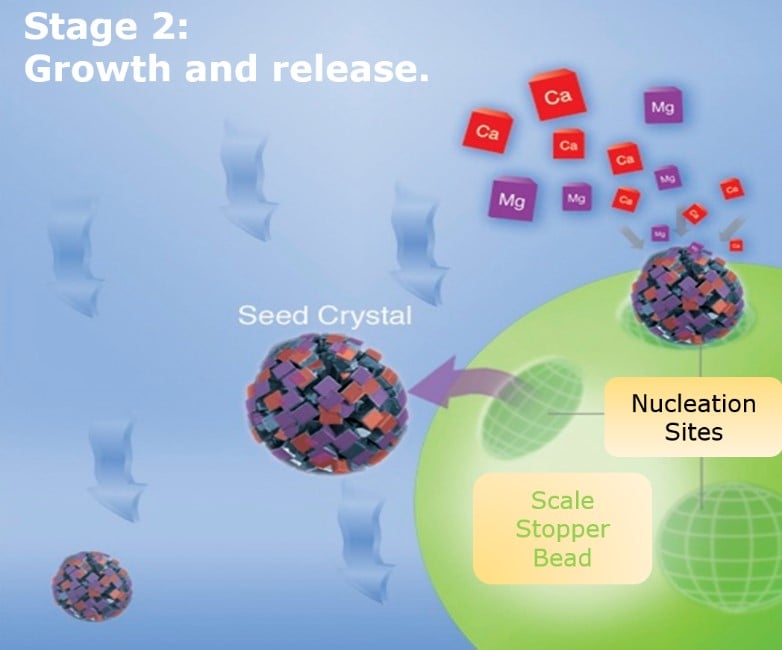
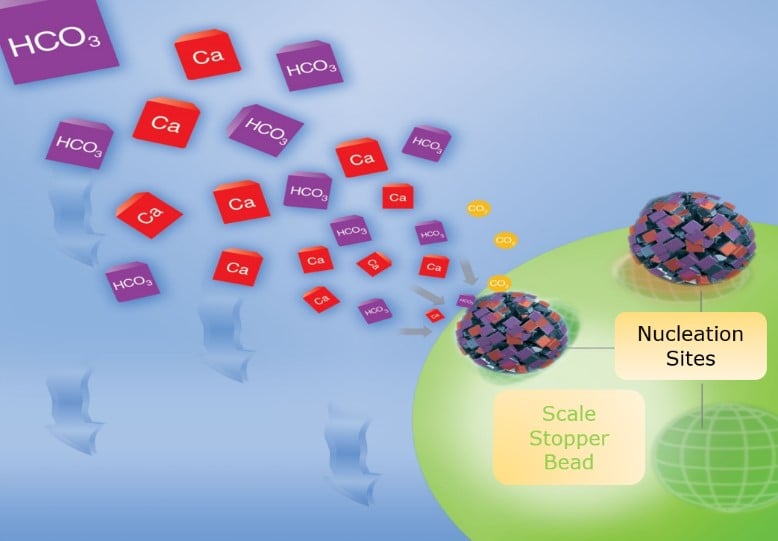
The diagrams below show calcium and magnesium ions attaching to nucleation sites on a Scale Stopper bead (green). A crystal forms at each of the nucleation sites with the accumulated ions. Once this crystal reaches the nanometer size range, it will be released back into the flow as an inactive particle in the water. These inactive particles are unable to form scale. The treated water will actually then gradually work away at the existing hardness deposits.

TAC Diagrams

ASU Study

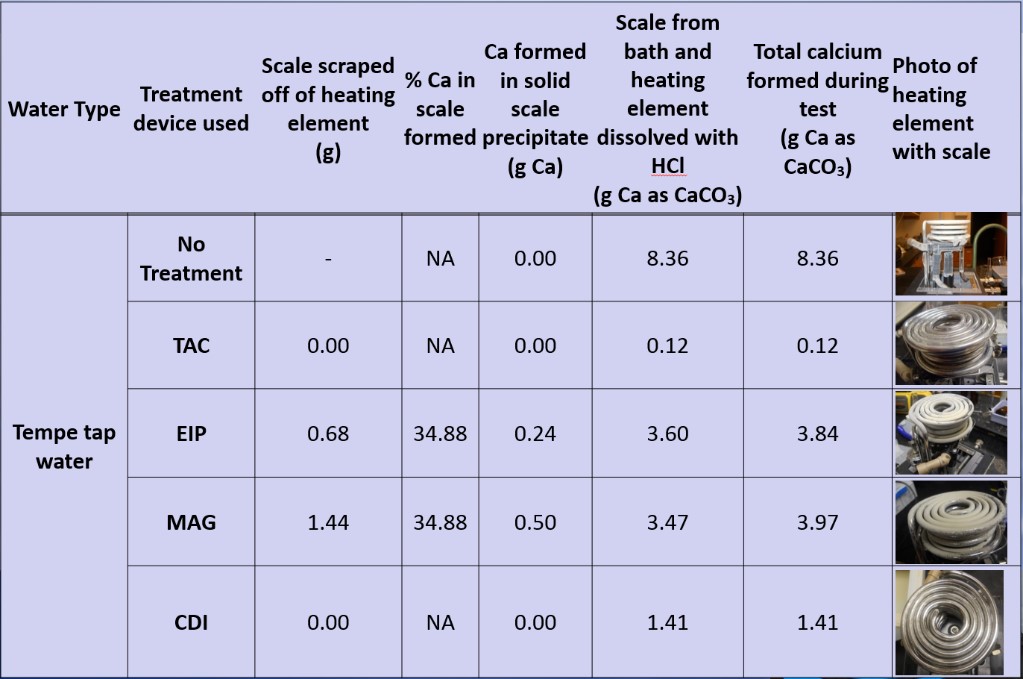
An experiment at Arizona Sate University showed the TAC technology to be the most effective scale remover using Tempe’s tap water as a test subject. Scale Stopper’s TAC proved to be 97+% effective at two different temperatures, passing the German Technical and Scientific Association for Gas and Water test with flying colors.
ASU results table

Comparison methods included: Electromagnetic Treatment, Electrically Induced Precipitation, Capacitive Deionization, and No Treatment. A table of the results is below, as well as a graph to visually represent the results from the study. Pictures to the right show how much scale remained after each treatment.

Visit our slideshare profile for a comprehensive presentation outlining how the Scale Stopper works in further detail.

Like, Share, and Join Our Community
Gerry Bulfin

Gerry Bulfin is the founder and owner of Clean Water Systems & Stores, Inc. (Clean Water Store) in Santa Cruz, California, which he started in 1986. He is a WQA Master Water Specialist, WQA Certified Installer, California Grade II Water Treatment Operator, and California Licensed Contractor (C-55 Water Conditioning), CSLB #1003944. Gerry is a long-time member of the Water Quality Association (WQA), the National Ground Water Association (NGWA) and the American Water Works Association (AWWA), and shares practical, test-based advice on choosing, installing and maintaining well and city water treatment systems.

Recent Posts

Why Does My City Tap Water Smell Musty or Earthy Right Now?

If your tap water has started smelling or tasting a little "off" this week: earthy,…

3 months ago

Why Does My Well Pressure Drop in Summer? (And What it Costs to Fix)

If your water pressure has been weaker than usual this month, you're not imagining it.…

3 months ago

Is Your City Testing for This?

Is Your City Testing for This? Every year, your water utility sends out a report.…

3 months ago

Acid Neutralizer vs. Soda Ash for Well Water: Which One Do You Need?

Article last updated July 2026 If your well water is acidic, with a pH below…

3 months ago

What Water Treatment System Do I Actually Need? A Buyer’s Guide by Symptom

Most homeowners come to us knowing something is wrong with their water. The smell, the…

3 months ago

Carbon Backwash Filter for City Water: What It Does, What It Doesn’t, and How to Size It

If you are on city water and dealing with chlorine taste and odor, chemical smell…
3 months ago