_2.png)
 Request a Call
Water Neutralizer

If you use multiple treatment systems for your well or city water, you have probably wondered whether the order of installation affects the final quality of your treated water. The answer is yes, the order of your treatment systems can be a factor in determining the effectiveness of your systems. A customer using an iron filter and water softener for his well water recently wrote to us, explaining that he wanted to add a neutralizer to this configuration but was unsure where to install it on his line.
We recommended that he install his neutralizer first, followed by the iron filter and then the water softener. We also suggested that he use a pre-filter, such as a Lakos Twist II Clean sediment filter, to prolong the life of the media in the neutralizer and other systems. Here is a handy diagram to illustrate how these systems should be installed for maximum effectiveness:
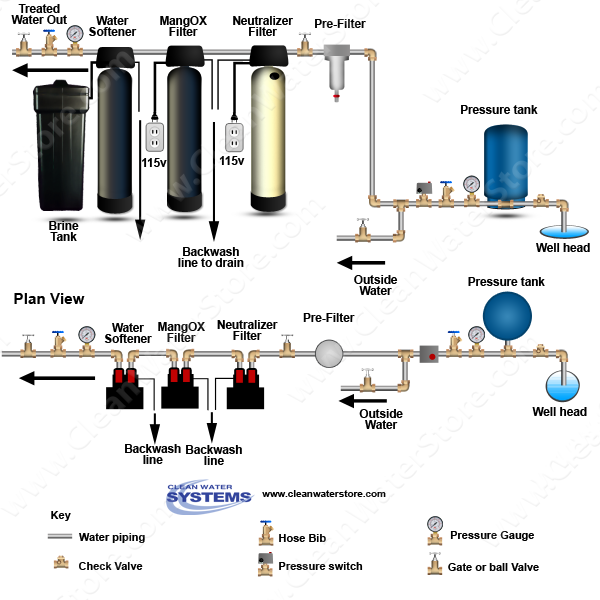
Note that the diagram above illustrates the best order of installation for any combination of the systems pictured therein, not just this specific configuration.
Water Neutralizer: Here’s a Bit More Information on the Systems Mentioned Above
We recommend Lakos Twist II Clean sediment filters because they are effective pre-filters that are very easy to use and clean—simply twist the handle at the top of the filter to begin the patented reverse flushing action, and watch your filter backwash itself from the inside out.
How Acid Neutralizers Work
For the neutralizer, we recommend an acid neutralizer, specifically the Calcite Neutralizer 7500-SXT, which is designed to raise the pH of acid water (low pH water) to a balanced, neutral level. Acid neutralizers, such as this neutralizer system, treat well water with low pH to protect plumbing and appliances. The system helps prevent copper staining and leaching by neutralizing low pH water, which can otherwise corrode copper pipes. The calcite media used in this unit is made of calcium carbonate, which is slowly dissolved as water flows through, raising the water’s pH.

This process happens gradually, as the media slowly dissolves over time. To maintain performance, you’ll need to refill or replace the media as needed. The size of the neutralizer system and tanks determines how long the media will last before requiring maintenance.
The neutralizer’s inlet connects easily and promotes optimal water flow through the media bed. If your well water contains iron, adding an iron filter can help prevent staining on sinks and fixtures. Pairing the acid neutralizer with a water softener also helps treat hard water caused by high levels of calcium and magnesium.
Understanding Acidic Water
Acidic water is a common concern for many homeowners. It is typically identified by a pH level below 7.
When your water is acidic, it can slowly corrode your plumbing system. This may lead to leaks, pipe damage, and the release of heavy metals—such as lead—into your drinking water.
The issue often starts from natural causes. For example, rainwater can absorb carbon dioxide from the air, forming weak acids. Human activities can also increase acidity in surface water sources.
If left untreated, acidic water can damage your pipes and fixtures. It may also affect the taste and safety of your drinking water.
Recognizing the signs of acidic water and understanding its effects is the first step toward protecting your home and health.
Benefits of Neutralization
Investing in a neutralization system offers a range of benefits for your home and water supply. By neutralizing acidic water, you can prevent corrosion in your plumbing system, which reduces the risk of leaks and costly repairs. This process also helps to stop heavy metals from leaching into your water, protecting your family from potential health hazards. Improved water quality means your appliances, such as water heaters and dishwashers, will last longer and require less maintenance.
Additionally, neutralized water is safer and more pleasant for drinking, cooking, and bathing. Overall, a neutralization system is a smart investment that safeguards your home, reduces maintenance needs, and ensures your water remains clean and safe.
Read more:
Maintenance and System Design Tips
These filters come with instructions for using the calcite and Corosex media. They can be installed by anyone familiar with basic plumbing.
Acid neutralizer units require minimal maintenance. Simply backwash once a week for about 8 to 10 minutes to keep the calcite operating effectively. Regular backwashing helps prevent the media from becoming blocked by sediment or calcite buildup.
Advanced distributor designs offer benefits over traditional gravel-bedded tanks. They help eliminate channeling and calcification issues. This improves flow rates and extends media life while also reducing water usage during backwashing.
There is a key difference between upflow and backwashing acid neutralizer units. Upflow systems push water upward through the media. Backwashing units reverse the flow periodically to clean the media and maintain performance. This difference impacts how often maintenance is needed and how efficiently the system runs.
Read more:
Final Reminders and Installation Tips
Other user-friendly features include a simple bypass valve and top-fill plug, making it easy to add more calcite with minimal time, cost, or effort. The media typically only needs to be refilled every few years, depending on your household’s water usage.
It is important to follow the owner’s manual for proper installation and maintenance, as this may be required for warranty coverage. Balancing the water’s pH with pH neutralizers is essential to protect plumbing and appliances. The system is suitable for treating well water, which often has low pH and may require acid neutralization. Note that tanks should not be exposed to vacuum conditions, as this can cause damage and void the warranty.