_2.png)
 Request a Call
Hydrogen Peroxide Well Water Systems
Rotten-egg smell in your well water, often worse on the hot side? That's hydrogen sulfide gas. A peroxide system injects a measured dose of hydrogen peroxide each time water flows, then a catalytic carbon filter removes what's left. No chlorine taste, and the peroxide breaks down into water and oxygen.
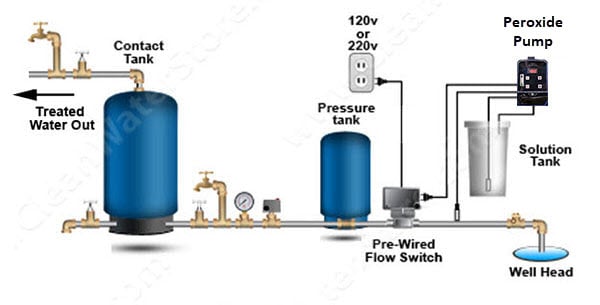
A complete system has three parts:
- J-PRO-38 injection pump on a solution tank: the 15-gallon tank fits most homes.
- Contact tank: recommended for strong odor, iron or sediment; optional for mild odor.
- Catalytic carbon backwash filter: removes the oxidized sulfur and iron and any leftover peroxide.
Which parts does your water need? See the guide below the products.
2 Items


$1,732.00
Which Peroxide System Does Your Water Need?
| Your water | What you need |
|---|---|
| Mild rotten-egg smell, no iron or sediment | J-PRO-38 pump + catalytic carbon backwash filter |
| Strong smell, or smell plus iron or sediment | J-PRO-38 pump + 15-gallon contact tank + catalytic carbon filter |
| Smell plus high iron or manganese | The system above, then a Pro-OX or GreensandPlus iron filter after the carbon |
| Constant-pressure (variable-speed) well pump, or injecting after the pressure tank | J-PRO-38 in proportional mode with a pulse water meter |
| Coliform bacteria on your water test | Peroxide does not disinfect. Add a UV sterilizer or a nano-ceramic bacteria filter as the last stage |
When Peroxide Is the Wrong Call
- The smell is only in the hot water. That usually comes from the water heater's anode rod, not the well. Check the cold tap first: if the cold side doesn't smell, start with the water heater.
- You need disinfection. Peroxide removes odor and oxidizes iron, but it is not a drinking-water disinfectant (see the bacteria row above).
- You're planning carbon alone. A carbon filter without peroxide removes the smell for about six weeks, then stops working. The peroxide does the heavy lifting; the carbon finishes the job.
How a Peroxide System Works
- Inject. The pump feeds a small dose of diluted peroxide into the water line while water is flowing.
- React. Peroxide converts hydrogen sulfide to sulfur or sulfate, which doesn't smell, and turns dissolved iron and manganese into particles. It reacts faster than chlorine.
- Filter. The catalytic carbon backwash filter traps the particles and breaks any leftover peroxide down into water and oxygen.
The short version to tell anyone else: the contact tank isn't a filter, it's a mixing chamber. The peroxide needs time to work before the carbon sees it.
How the Pump Turns On and Off
The pump must run only when water is flowing. There are three ways to set it up:
- Wire it to the well pump pressure switch. Lowest cost. The peroxide pump runs on the well pump's circuit. Inject before the pressure tank.
- Use a pre-wired flow switch. Plug the flow switch into an outlet and the pump into the flow switch. No electrician needed. Inject before the pressure tank.
- Use proportional feed with a pulse water meter. The dose follows the flow rate. Use this to inject after the pressure tank or with a constant-pressure well pump.

Watch: J-PRO-38 Setup, Step by Step (7 minutes)
Mounting the pump, connecting the foot valve and injection check valve, priming, and choosing manual or proportional mode.
J-PRO-38 Peroxide Pump at a Glance
- For well water flow rates from about 1 to 50 gallons per minute
- Pumps 2 to 38 gallons of solution per day
- Line pressure up to 100 PSI
- 110V or 220V, 50/60 Hz; 30 watts or less
- Adjustable stroke length and frequency; manual or proportional mode
- Diaphragm pump: no pump tubes or rollers to wear out, unlike peristaltic (Stenner-style) pumps
What's Included with the Pump
- J-PRO-38 peroxide injection pump
- Heavy-duty polyethylene solution tank: 10, 15, 25 or 50 gallon
- Injection check valve (1/2" male pipe thread)
- Suction tubing and foot valve
- Tubing and fittings from pump to tank and injection check valve
- Degassing / priming valve
- Manual
Which Solution Tank Size?
The 15-gallon tank fits most homes; the 50-gallon is rarely needed. Diluted peroxide loses strength, so mix only enough to last about 60 days.
| Tank | Footprint with pump (W x H) |
|---|---|
| 10 gallon | about 14" x 24" |
| 15 gallon | about 16" x 29" |
| 25 gallon | about 18" x 32.5" |
| 50 gallon | about 22" x 41.5" |
Which Peroxide, and How Much Per Month?
- Use certified 7% hydrogen peroxide, diluted further for most homes (instructions included).
- Stored cool, dark and dry, the 7% keeps 8 to 12 months before mixing.
- Most homes use one-half to one gallon of 7% a month. At a 10 ppm dose, one gallon treats about 7,000 gallons of water.
What a Peroxide System Costs
- J-PRO-38 pump with 15-gallon tank: $825
- 15-gallon contact tank (if needed): $429
- Catalytic carbon backwash filter: $1295
- Peroxide: a 5-gallon pail of 7% ($89) lasts most homes 5 to 10 months, or about $10 a month.
- Typical complete system for strong odor: $900 to $3000 in equipment.
Is Peroxide-Treated Water Safe to Drink?
Yes. The dose is small, it breaks down into water and oxygen, and the catalytic carbon removes anything left before the water reaches your taps. Unlike chlorine, nothing stays behind in the water.
Every complete system comes with a 6-month satisfaction guarantee.


