_2.png)
 Request a Call
How to Set Up A Well Water Chlorination System
Podcast: Play in new window | Download
Note: This podcast transcript has been edited for clarity and length.
In this episode, I discuss how to set up a well water chlorination system and much more.
I’m Gerry Bulfin, a water treatment contractor and WQA-certified Master Water Specialist.
Today, I discuss home well water chlorination systems and how, why, and when you should use one. I also review questions you should ask before using a chlorinator and explain how to chlorinate your water safely.
What You Will Hear in This Episode
Deciding on whether to use a well water chlorination system when your water is high in iron, manganese, sulfur odor, or especially if you have a combination of those
-
- What system is used to treat coliform bacteria in water
- How to set up a chlorinator system
- When and how to use UV sterilizers
- What is a good alternative to chlorination
- UV rays need to penetrate the water to disinfect it. What to do to make the water fit for UV sterilization
- Hydrogen Peroxide compared with chlorine in disinfecting residential well waters
- Why is chlorination most effective against bacteria
- What to do after chlorination to completely remove the chlorine from disinfected water
- When does chlorine become ineffective in disinfecting the water?
- What is the right amount of chlorine to inject, and at what rate?
- Should you get a solid pellet chlorinator or a liquid chlorinator?
- What to do when your well is 400 feet deep but your pump is only 300 feet
- How to figure out how much chlorine to add to the water or estimate the chlorine demand in the water
- The ideal should be that the chlorine residual is very tiny or nonexistent.
- When chlorine is added to the water, it reacts with bacteria and other impurities, such as hydrosulfite, soluble metals, iron and manganese particles, organic matter, and microorganisms
- Adding chlorine to counteract the oxides of iron, manganese, and hydrosulfite
- The more water you use in the house to maintain a constant pressure, the more or less you get
Why a Water Test Matters
-
- It’s important to have a general mineral analysis of your water. You want to know its pH and what treatment to apply.
- With a standard chlorine system, inject it into a flow rate that stays consistent.
- Try to stop the bacteria at the source, not at its current location.
Understanding Alternatives to Chlorination
Hello. Thanks for tuning in again to the Clean Water Made Easy Podcast. I’m Gerry Bulfin, a water treatment contractor and WQA-certified Master Water Specialist. I hope you’re having a good day and everything’s going great in your neck of the woods.
In this series, you can learn useful, easy-to-follow tips and information about well water, well water treatment systems, and how to improve the quality of your well water.
In today’s episode, I’m going to talk about home well water chlorination systems, why you might want to use a chlorinator, how chlorinators compare with other types of systems such as UV, Ozone, and Hydrogen Peroxide as well as different types of chlorinators and questions to ask yourselves when setting one up.
We are going to talk about solid chlorine pellet feeders vs. liquid bleach feeders and how to install it so you’re not drinking or bathing in water with chlorine in it.
When to Use a Chlorinator
So, you might want to consider a chlorinator if your water is high in iron, manganese, or sulfur odor—especially if you have a combination of those. As a pre-treatment to your filtration, consider a chlorinator if your water has coliform bacteria in it.
Say you have a shallow well under the influence of surface water, and you can’t fix that. Or you have a cistern fed by rainwater, or maybe iron bacteria or sulfate-using bacteria. A chlorinator is good for that.
Featured Product: J-PRO-38 Chlorination System
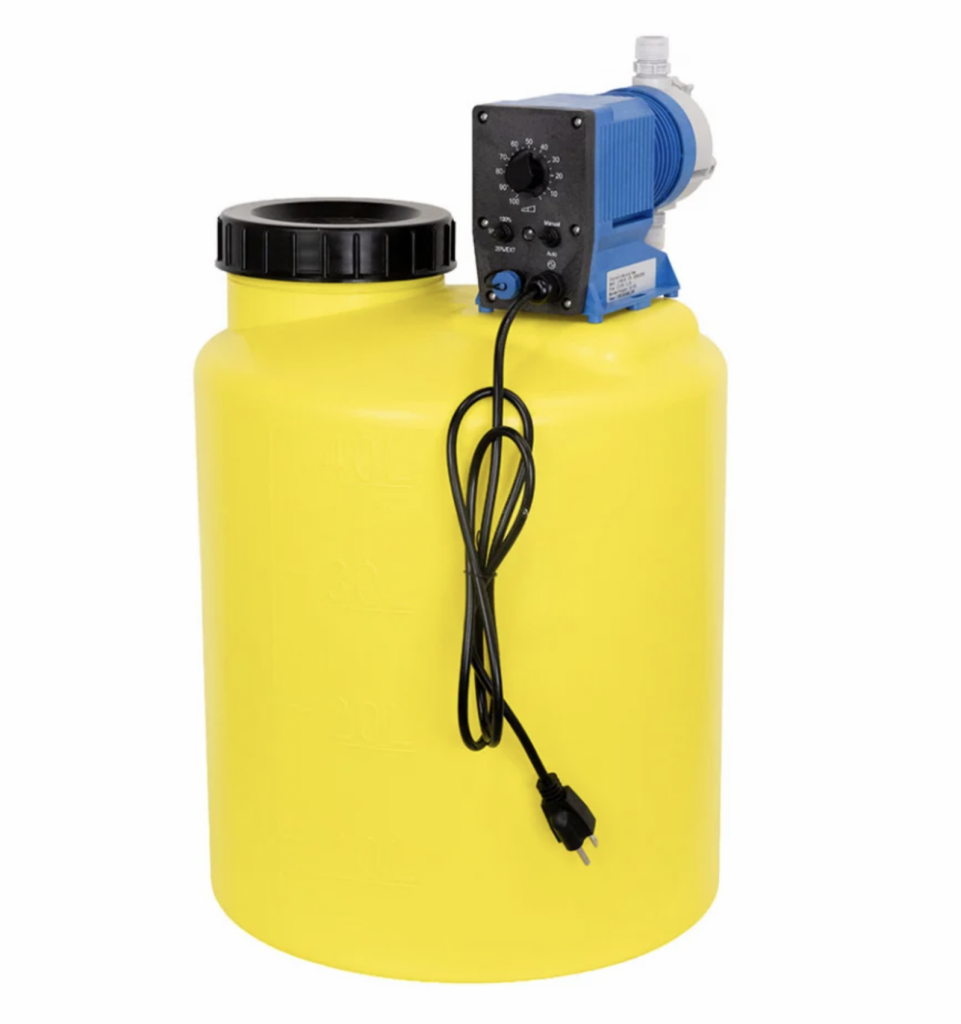
For an easy, reliable way to disinfect your well water, we recommend the J-PRO-38 Chlorinator Pump System. It uses a precision metering pump to inject chlorine at the right rate based on your system’s flow. Perfect for treating bacteria, sulfur odors, and iron. Learn more here.
* Note that we have updated our product line from the J-Pro-22 to the new J-Pro-38.
UV, Ozone, and Peroxide Explained
Many folks will ask, “Why not use ultraviolet sterilizers?” Or what about ozone or peroxide?
Lots of people want to avoid chlorine—and for good reason. It’s generally not ideal to drink chlorinated water, though millions do daily. While long-term effects are minimal, if you’re on a private well, it’s understandable that you don’t want chlorine in your drinking water.
So, they ask, “What’s a good alternative?” UV is a great option. We’ve recommended it to customers for years. UV light is effective—if your water is clear.
Important Note About Water Clarity
UV rays must penetrate the water to disinfect it. If your water has iron, manganese, or odors, UV won’t work unless you filter and soften it first. In those cases, chlorination does a better job.
Ozone is even more powerful than chlorine. We’ve used ozone since 1989 and installed hundreds of systems. The challenge is cost and complexity. If ozone were easier and cheaper, it would be better than chlorine in many cases.
Hydrogen Peroxide and Its Limitations
Hydrogen peroxide is another popular option. While many people think it’s a strong disinfectant, it’s not ideal for drinking water.
It’s not approved as a stand-alone disinfectant and is far weaker than chlorine or ozone. Peroxide is great for removing odors, but doesn’t kill bacteria well. It works better when paired with UV or ozone.
Why Chlorination Is Still Most Popular
Water used for drinking and cooking should be free of odor, slime, and bacteria. Chlorination is the most commonly used method because it’s cheap and effective.
It doesn’t kill all organisms like cysts or parasites, so it’s often combined with filtration. Inject chlorine, allow contact time, then filter it out. It’s effective and reliable.
Many people don’t want chlorine in their water. That’s valid. Fortunately, it’s easy to remove using activated carbon.
Resource:
Also, Read Our How-To Guide: How Much Chlorine To Add to Storage Tanks to Kill Bacteria

Article last updated June 1, 2026 by Author.


