Shopping Cart

Your cart is currently empty.

Secure Checkout
Sediment

There are many causes for "sediment" in water. Although sediment — those particles that settle out in a jar of water — is often described as looking like dirt, soil or sand, sometimes it is caused by dissolved metals such as iron that precipitate out of solution. Identifying the cause correctly is what determines which filter or system will actually work.

In private well water, what appears to be sand is often particulate material from an entirely different source.

Common causes of sediment in water

  • Iron or manganese oxides (rust)
  • Silt or sand carried up from the groundwater itself
  • Sand, grit or particles from pipelines that weren't properly flushed after repairs
  • Decaying piping and distribution systems
  • Deteriorating water heater liners and dip tubes
  • Failing storage tank liners, pressure tanks, or pumping systems
  • Black ferric sulfide following hydrogen sulfide odors
  • Sediment from a malfunctioning treatment plant
  • Softener resin or filter media escaping from a failed treatment system
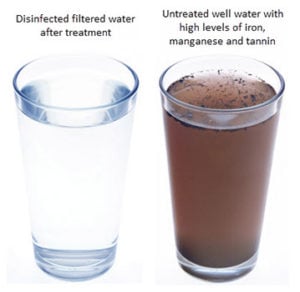
Treated and untreated well water side by side in glass jars

How to identify what you're dealing with

Before choosing a filter, run two quick checks at home. Fill a clear glass jar from a cold tap and let it stand for an hour. Particles that sink are usually sand, silt or grit. A reddish-brown cloud that settles slowly points to oxidized iron rather than true sediment. Water that starts clear and turns cloudy or rusty after sitting means dissolved iron is coming out of solution — a sediment filter alone will not fix that.

Second, check whether the sediment appears on both hot and cold taps. Particles on the hot side only usually mean a failing water heater dip tube or liner, not a well problem.

Treatment options for sediment

Whole house cartridge filters
Lowest cost and simplest to install. Best for light sediment loads. Cartridges are replaced by hand, so heavy sediment means frequent changes.

Spin-down filters
A reusable screen that traps coarse sand and grit. Flush the collection bowl instead of buying cartridges. Often installed ahead of another filter to protect it.

Backwashing self-cleaning sediment filters
Automatically flushes trapped sediment to drain on a set schedule. No cartridges to change. The right choice for heavy or continuous sediment, and for anyone who doesn't want ongoing maintenance.

Cutaway view of a 5900-BT backwashing well water sediment filter

Choosing the right micron rating

Filters are rated by the size of particle they capture, measured in microns. A lower number catches finer particles but clogs faster and can restrict flow. For most well water, start around 20 microns to remove visible grit, then add a finer stage only if the water is still cloudy. Going straight to a very fine filter on sandy water usually results in a filter that plugs within days.

A note on flow rate

Size the filter to your well pump's flow rate in gallons per minute, not to your pipe size. An undersized filter restricts pressure throughout the house and shortens its own service life. If you don't know your flow rate, you can measure it with a bucket and a watch in a few minutes.

Not sure which filter fits your water?

USE THE SYSTEM SELECTOR ORDER A WATER TEST
How to Remove Sediment from Well Water
  • Water Quality Association member
  • WQA Certified Water Specialist
  • American Water Works Association member
  • BBB Accredited Business, A+ rating
  • National Ground Water Association member