Well Water Chlorination Systems
- Kill harmful coliform and ecoli bacteria*
- Eliminate sulfur (hydrogen sulfide) odors
- Oxidize iron, manganese for easier filtration
- Easy to install yourself or by any plumber
- Low cost and very effective
- Choose chlorine bleach, pellets, or powder



Frequently Asked Questions
Q. My well water has tested positive for coliform bacteria, is chlorination the best method for disinfecting my well water?
A. Chlorination can be the best method, depending on the water chemistry and the application. The main advantage of chlorination is that the chlorine injection is relatively inexpensive to set up, and a chlorine residual can be inexpensively detected in the distribution lines of the piping system assuring proper disinfection.
In other words, unlike UV sterilizers or ozone, which are also used for disinfection, a chlorine residual can be easily detected, which usually means the water is properly disinfected.
In other words, unlike UV sterilizers or ozone, which are also used for disinfection, a chlorine residual can be easily detected, which usually means the water is properly disinfected.
*NOTE: if your well water contains coliform bacteria or e.coli bacteria it is important to find the source and stop the contamination. If your well is under the influence of surface water contamination, a chlorination system alone will not be considered a 100% safe alternative to having uncontaminated, safe well water. Sufficient contact time after the chlorine has been injected is critical to achieving disinfection. A bacteria filter or an ultra-filtration system may be needed to ensure safe water if your well is under the influence of surface water.
Q. How do I know which chlorinator (metering pumps and solution tank) to get for my application?
A. If you are a homeowner with a well pump that has a 1/2 hp to 2 hp pump, our J-PRO-22 Chlorinator Packages provide the lowest maintenance and are the easiest to use. These systems are easily adjustable to get the correct chlorine residual you need. If you want to use a pellet feeder, we also offer. If you want to use a pellet feeder, we also offer in-line dry pellet chlorine pellet feeders. The chlorine residual can be a little harder to control with a chlorine pellet feeder and are more expensive to operate than the J-Pro-22 Chlorinator systems which use chlorine bleach.
Q. How do I know how much chlorine to inject?
A. This depends on the "chlorine-demand" of your water. For disinfection purposes a 1 to 2 ppm residual is usually applied, assuming the water has sufficient contact time. We typically recommend a 5 to 10 minute contact time after the chlorine has been injected. If your water contains iron, manganese, sulfur odors, tannins or other substances that will increase the demand placed on the chlorine, then higher residuals will be needed. However, this doesn't change the size of the system. For most homeowners, the smallest system we offer will work fine and you can then adjust the strength of the chlorine solution you are injecting (by diluting it with water) or adjust the output of the pump from 10% to 100% output.
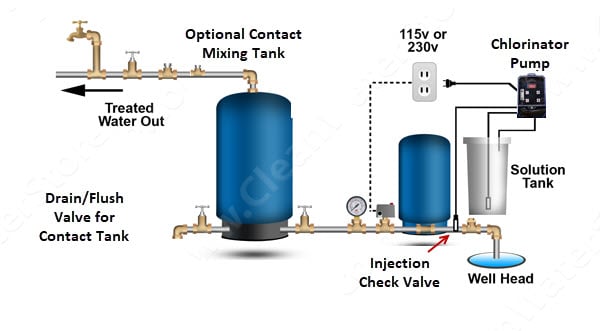
Q. How are home well water chlorinators installed?
A. Please see this diagram below. The chlorine is typically set up to inject before the pressure tank and the chlorinator pump runs only when the well pump is running. It can be wired to turn on and off with the well pump, or a flow switch option can be used:
Q. What are my other options for disinfecting the water of bacteria?
A. Two other types of disinfection systems we carry, are ultraviolet sterilization and ozone systems. The advantage of these systems is that there is no chlorine tastes or odors in the treated water. This same feature could be a disadvantage, however, since it is harder to know for sure that complete disinfection has occurred without continually testing for bacteria. With chlorination, a simple chlorine residual test can allow you to know that the water still has With chlorination, a simple chlorine residual test can allow you to know that the water still has the potential to disinfect the water.
Q. Why would I want to use an ozone or an ultraviolet sterilizer in place of a chlorinator?
A. An ozone or ultraviolet sterilizer, properly set up and installed, can be easier to maintain than a chlorinator. A liquid chlorine injection system for instance, requires that one add fresh solution to the solution tank every one to two months (ideally), whereas an ozone or ultraviolet sterilizer can go for six to twelve months without routine maintenance. However, ozone and UV systems are often more expensive to purchase upfront and more expensive to operate over time.
Q. I am on a small community system in the United States, and I have been informed that our water has a coliform problem, is chlorination the best approach for our entire community system?
A. Generally, yes. Public health agencies want to make sure that there is a small residual of "free" or available chlorine out in the distribution system or piping of community, to make sure that any bacteria are killed that occur or originate out in the distribution system. An ultraviolet sterilizer or ozone system will provide no disinfectant residual. Often we use ozone as a primary oxidizer or disinfectant at the main holding tank, as part of a treatment process, but we almost always recommend that a slight chlorine residual be used as a final step, to protect the distribution system piping.
Q. My community system or small shared well system periodically has coliform bacteria problems, but the other residents on the system do not want to, or have no plans to chlorinate. Is there anything I can do, just at my own home?
A. Yes, you can install a proportionally-fed chlorine injection system, which injects more or less based on the flow rate of your water. Our standard chlorinator systems are installed before the pressure tank where the water is flowing more or less at the same flow rate, so a proportional-fed is not required. Another option if your water is clear, and low in iron and manganese, you could install an ultraviolet sterilizer right at your home, to disinfect only the water that comes directly to your house.
Q. Isn't chlorine toxic and cancer-causing?
A. High levels of chlorine are toxic, but low levels (as found in most municipally treated water) are not acutely toxic. There is controversy over the actual carcinogenic effects of long-term low exposure to chlorine. However, it is relatively easy to dechlorinate water for showering and drinking by using a low-cost whole house carbon filter.
Q. When should I use an in-well chlorine pellet feeder, as opposed to a liquid chlorine bleach injection system?
A. A pellet feeder, which drops small chlorine pellets down the well, every time the well pump runs, can be a good solution if you have no holding tank or retention tank, which is usually required for liquid chlorine injection. Pellet feeders can be ineffective if your well has wire Pellet feeders can be ineffective if your well has wire protectors or other obstructions that block the pellets from falling. If your well has a small access plug on the top of it, you can obtain some pellets and drop a few down the well to see if they fall into the water, which you can usually hear pretty clearly. Pellet feeders are often much more expensive to operate, as the pellets cost more than liquid sodium hypochlorite (bleach). Most of our clients using chlorination, use liquid sodium hypochlorite injection, but pellets are useful in some cases. Pellet feeders are often much more expensive to operate, as the pellets cost more than liquid sodium hypochlorite (bleach). Most of our clients using chlorination, use liquid sodium hypochlorite injection, but pellets are useful in some cases.
Q. Can I really just use regular household bleach to sanitize my water?
A. We don't recommend laundry bleach, as it has other chemicals such as stabilizers and preservatives. Laundry bleach which is approximately 5% sodium hypochlorite, will sanitize your water, but a better alternative is to use chlorine bleach granules which have been NSF certified for use in drinking water. You can also use liquid pool chlorine which (12% sodium hypochlorite) as long as it does not have additives or contaminants.
Q.I know I have bacteria in my water, should I have my water tested for other things besides bacteria?
A. Its a good idea to have your water tested first, since there can be other parameters, such as pH, iron, manganese and turbidity that can affect the dosage and contact time of the chlorination. If you have further questions you can then contact our technical staff for help on selecting the best system for your application. Or if you just have general questions, you can contact our staff before having your water analyzed, but it is often very difficult to specify a proper system without a complete water analysis, including general mineral and bacteriological, at a minimum.
Q.Should all well water be disinfected (sanitized of bacteria)?
A. Generally yes, however, the vast majority of private wells in the US and Canada have no disinfection of any kind, and actual waterborne disease outbreaks appear to be rare. If the well is less than ten years old and properly constructed with a sanitary seal, and the lab test comes back with no coliforms detected, then often disinfection is not required. If the well is older, has a cracked or missing seal, is shallow (less than 100 feet deep) or is under the influence of water from surface run-off, then it may be a good idea to disinfect the water, or test routinely for coliforms, particularly during rainy periods.

Any other questions? Please email us or call us toll-free at 888-600-5426.