_2.png)
 Request a Call
Acid Neutralizer vs. Soda Ash for Well Water: Which One Do You Need?

Article last updated July 2026
If your well water is acidic, with a pH below 7.0, it is slowly corroding your pipes, leaching copper and lead into your water, and shortening the life of your water heater, fixtures, and appliances. The blue-green stains on your sinks and tubs are copper. The pinhole leaks in your plumbing are the long-term result.
The good news: low pH is one of the most straightforward well water problems to fix. The challenge is that there are two different treatment approaches, a calcite acid neutralizer tank and a soda ash injection system. Choosing the wrong one for your pH level and water chemistry means either a system that doesn’t fully solve the problem or one that’s more complicated than you need.
This guide explains exactly how each system works, when to use each one, and how to choose based on your actual water test results. Whether you end up buying from us or not, our Learning Center exists to educate consumers about their choices in water treatment.
Why Low pH Well Water Is a Problem
pH measures how acidic or alkaline your water is on a scale of 0 to 14. A pH of 7.0 is neutral. Below 7.0 is acidic. Most well water problems with corrosion occur when pH falls below 6.5.

Acidic water is aggressive, meaning it attacks metal surfaces it comes into contact with. In a home’s plumbing system, this means:
-
- Copper pipes leach copper ions into the water, causing blue-green staining and elevated copper levels
- Lead solder and brass fittings in older homes leach lead, a serious health concern with no safe exposure level
- Water heater elements and tanks corrode faster, reducing efficiency and shortening life
- Pinhole leaks develop in copper pipes over time, often inside walls where they go undetected until major damage occurs
- Iron and steel components in the water system rust and fail prematurely
According to the Alabama Cooperative Extension System, corrosivity, the tendency of water to dissolve metals, is directly related to low pH, and treatment is one of the most reliable ways to protect your plumbing investment.
The most common cause of acidic well water is dissolved carbon dioxide from the atmosphere or soil, which forms carbonic acid in groundwater. Geology matters too. Wells drilled in granite, quartz, or sandy soils have little natural buffering, while limestone-rich geology tends to produce higher-pH water naturally.
Option 1: Calcite Acid Neutralizer Tank
How It Works
A calcite neutralizer is a tank, similar in size to an iron filter or water softener, filled with calcium carbonate (calcite) media, sometimes blended with magnesium oxide (sold under brand names like Corosex or Flomag). Water flows through the tank, and as it contacts the media, the calcite slowly dissolves, releasing calcium and bicarbonate ions that buffer the water and raise the pH.

The process is entirely passive, meaning no pump, no chemicals, no electricity required. The media simply dissolves at a rate determined by the water’s acidity and flow rate. More acidic water dissolves more calcite per gallon; higher flow rates reduce contact time.
Two configurations are available:
-
- Backwash neutralizer — uses an automatic control valve that periodically backwashes the media bed to prevent compaction and flush out any accumulated sediment. Better for higher flow rates and higher iron content.
- Upflow neutralizer — water enters from the bottom and flows up through the media without backwashing. Simpler, no drain connection required, well-suited for lower flow rates and clean water with minimal sediment.
What pH Range It Handles
Calcite works reliably for pH between 6.0 and 6.9. With a calcite and magnesium oxide blend, it can handle pH as low as approximately 5.5. Below that, calcite media may not dissolve fast enough at normal residential flow rates to consistently raise pH to the target range of 7.0 to 8.0.
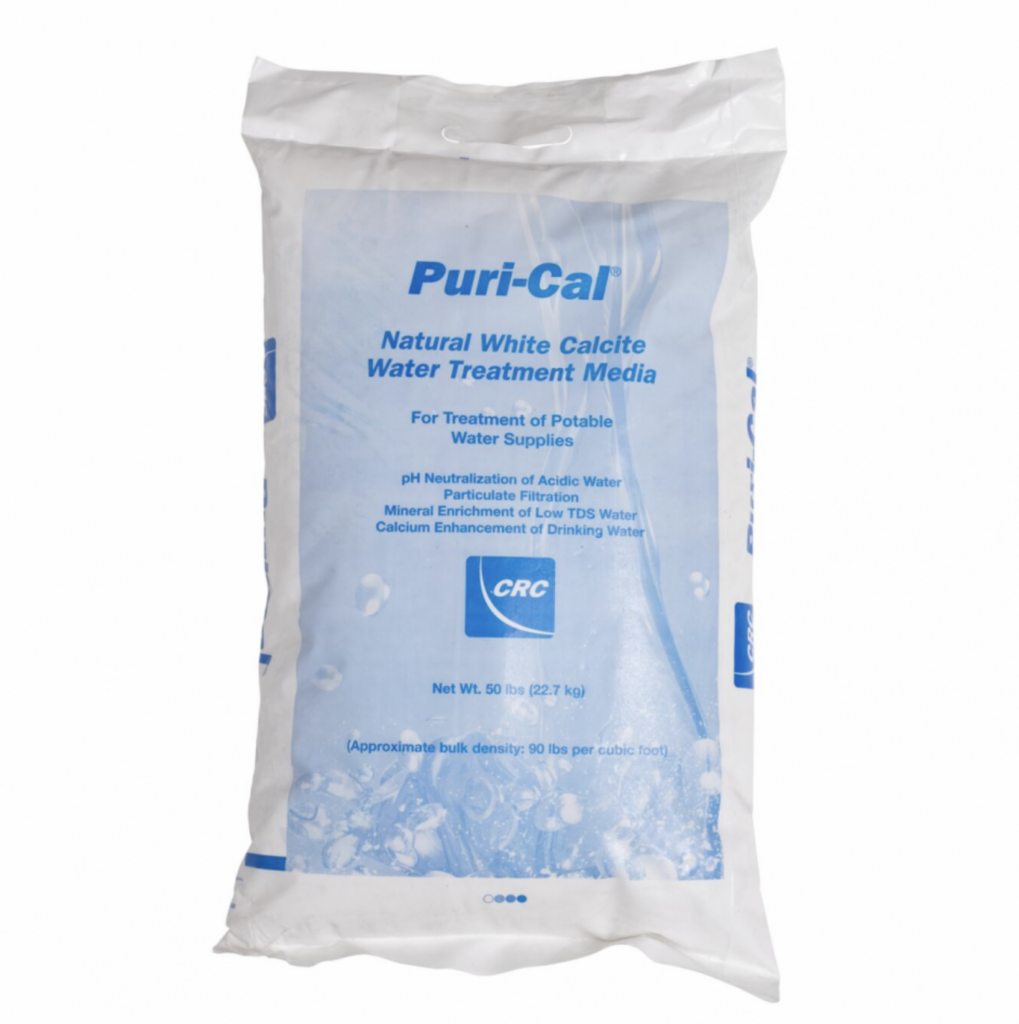
Calcite neutralizers are an effective and practical option for the pH range most commonly found in acidic private wells.
The Hardness Factor
This is the most important thing to understand about calcite neutralizers: because calcite is calcium carbonate, raising pH with calcite adds calcium hardness to your water. For most acidic well water, which tends to be naturally soft, this is not a problem. The water leaves the neutralizer slightly harder but still well within comfortable ranges.
However, if your incoming water already has elevated hardness above 10 grains per gallon, or if the pH is so low that raising it requires dissolving large amounts of calcite, the added hardness may warrant a water softener downstream. This is uncommon but worth checking with a water test before and after installation.
Maintenance
Calcite maintenance is minimal and one of the main reasons most homeowners prefer it over soda ash for residential applications. The media slowly depletes as it dissolves into the water. You check the level once or twice per year and refill when it drops below two-thirds full. No mixing, no calibration, no pump to maintain. A standard residential system is refilled approximately once per year.
Not sure which system your pH level requires?
Our WQA-certified specialists review water test results every day and help homeowners choose the right acid treatment system for their specific water chemistry and flow rate.
Option 2: Soda Ash Injection System
How It Works
A soda ash system uses a chemical metering pump, the same type used for chlorine or hydrogen peroxide injection, to inject a sodium carbonate (soda ash) solution into the water line. The metering pump is wired to the well pump pressure switch or a flow switch and activates whenever water flows, injecting a precise volume of soda ash solution proportional to water usage.
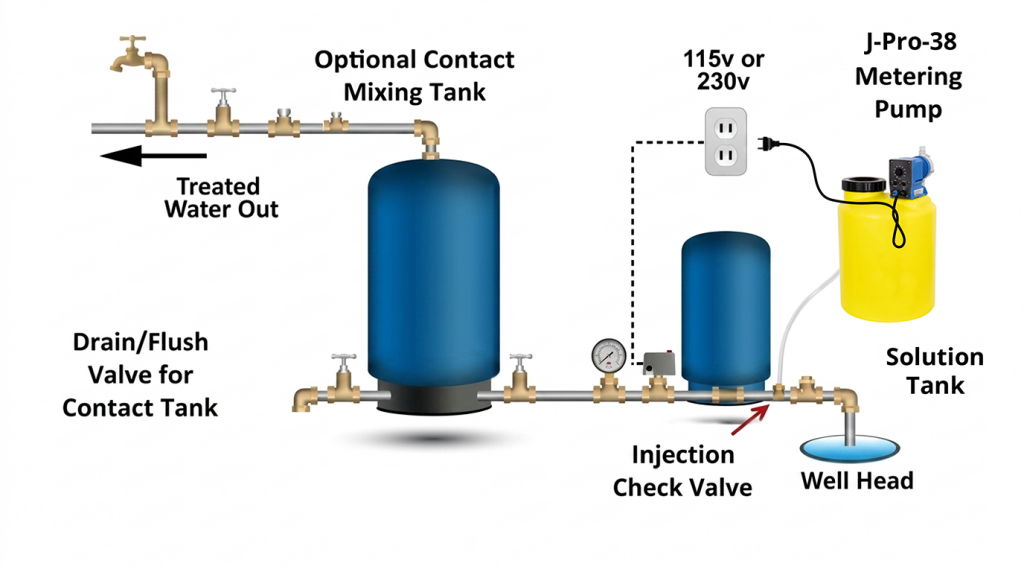
Sodium carbonate reacts with the acidic water, neutralizing hydrogen ions and raising both pH and alkalinity. Unlike calcite, it does not add hardness. It adds sodium instead.
A contact tank is often used downstream of the injection point to allow adequate mixing and reaction time before water reaches the rest of the treatment system or the household plumbing.
What pH Range It Handles
Soda ash injection handles the full range of acidic well water, from mildly acidic (pH 6.5) all the way down to severely acidic (pH 4.0 to 5.0) where calcite simply cannot keep up. For pH below 5.5, and especially below 5.0, soda ash is the reliable solution.
Soda ash is also the better choice when:
-
- Your water has high hardness and you cannot add more calcium via calcite
- You need precise, adjustable pH control. The injection rate can be dialed in and adjusted
- You are already running a metering pump for chlorine or peroxide and want to combine treatment
- Your flow rate is very high and calcite contact time is insufficient
The Sodium Factor
Soda ash adds sodium to the treated water. At typical injection rates of 100 to 200 ppm, the sodium contribution is small for most people. If you are on a sodium-restricted diet or have concerns about sodium intake, have your post-treatment water tested to confirm actual sodium levels and discuss with your doctor.
Maintenance
Soda ash systems require more active maintenance than calcite neutralizers. The solution tank needs to be refilled every few weeks to a few months depending on water usage. A 10% soda ash solution (4 lbs of soda ash powder per 5 gallons of water) is the standard mix. The metering pump needs periodic inspection and calibration. pH should be tested regularly to confirm the injection rate is producing the target pH at the tap.
This maintenance commitment is manageable but real. For homeowners who prefer a more hands-off system, calcite is usually the better fit, if the pH range allows it.
Side-by-Side Comparison
| Factor | Calcite Neutralizer | Soda Ash Injection |
|---|---|---|
| Best pH range | 6.0 to 6.9 (blend to ~5.5) | 4.0 to 6.9 |
| Adds hardness? | Yes, adds calcium | No,adds sodium instead |
| Maintenance | Refill media 1x/year | Refill solution, monitor pump regularly |
| Electricity needed? | Only for backwash valve | Yes, metering pump |
| Adjustability | Limited, media type and tank size | High, injection rate fully adjustable |
| Can combine with chlorine? | No | Yes, mix soda ash and chlorine in same solution |
| Best for | Most residential well water with mild to moderate acidity | Very acidic water, high hardness, high flow, or combined treatment needs |
The Decision Framework: Which One Do You Need?
Start with your water test result. pH is the primary decision point.
pH 6.0 to 6.9 — Calcite neutralizer is almost always the right choice. Lower maintenance, no pump required, reliable performance in this range. Size based on your flow rate. For pH closer to 6.0 or water with higher flow rates, consider a calcite and magnesium oxide blend for faster pH correction.
pH 5.5 to 6.0 — Either can work, depending on your water chemistry. A calcite and magnesium oxide blend may be sufficient if your flow rate is moderate and you have the incoming hardness headroom to accept additional calcium. If hardness is already elevated, or if you want more reliable pH control, soda ash injection is the safer choice.
pH below 5.5, especially below 5.0 — Soda ash injection is required. Calcite media cannot neutralize fast enough at residential flow rates to consistently hit 7.0 to 8.0 at very low pH. Soda ash is reliable, adjustable, and handles the full range of acidic well water.
High existing hardness above 10 gpg — Soda ash injection is preferred. Adding calcium from calcite on top of already-hard water creates a hardness problem that requires a softener. Soda ash raises pH without adding hardness.
Already running a chlorinator — Soda ash can be combined. If you have iron bacteria, coliform, or iron requiring chlorine injection, soda ash and chlorine bleach can be mixed in the same solution tank and injected with the same pump, simplifying your system while addressing both pH and disinfection.
What Goes After the Neutralizer
For a calcite neutralizer, no additional treatment is typically required for pH alone. If iron is also present, and it often is in acidic well water, an iron filter should be installed after the neutralizer. Correcting pH first significantly improves iron filter performance.
For a soda ash system, a contact tank downstream of the injection point allows proper mixing before water reaches household plumbing. A carbon backwash filter downstream removes any residual taste from the soda ash and polishes the water.
Read more about the complete treatment sequence: What Water Treatment System Do I Actually Need? A Buyer’s Guide by Symptom
The Right Starting Point: Test Your Water First
A simple pH test, either with a home test kit or as part of a full water analysis, gives you the number you need to make this decision. Without it you are guessing, and guessing leads to buying the wrong system or sizing it incorrectly for your flow rate.

At Clean Water Store, we help homeowners review water test results and choose the right acid treatment system every day. Whether your pH is 6.5 or 4.8, there is a reliable, properly sized solution for your specific water chemistry and household needs.
We hope this guide helps you make the right choice the first time.
Low pH well water? Let us help you find the right fix.
Schedule a free call with one of our WQA-certified water specialists. We review water test results and design the right acid treatment system for your water and your home.
Related Resources
Sources & Further Reading


