_2.png)
 Request a Call
What is backwashing and why does it matter in whole house water filtration?

Last updated: June 2026
How Backwashing Works — And What It Means for Your Whole House Filter
If you’ve been researching whole house water filters, you’ve probably seen the word “backwash” and wondered what it actually means, whether you need it, and how much maintenance is really involved. It’s one of the most common questions we get — and one of the most misunderstood parts of home water treatment.
The short answer: backwashing is your filter cleaning itself. But the longer answer is worth understanding, especially when you’re deciding between an automatic backwashing system like the 5900-BT and a simpler upflow system.
What Is Backwashing and Why Does It Matter?
Every whole house filter works by passing water through a bed of media — carbon, calcite, greensand, or whatever is appropriate for your water. Over time that media captures sediment, iron particles, organic matter, and other contaminants. If you never cleaned it out, the media would get clogged, your water pressure would drop, and the filter would stop working effectively.
Backwashing solves this by reversing the flow of water through the tank. Instead of water flowing down through the media bed, it flows up — lifting and tumbling the media, flushing the trapped particles out through a drain line. Think of it like shaking out a rug. The media gets refreshed and redistributed, ready to keep filtering effectively.

A properly backwashing system maintains consistent performance for years without significant intervention. One that never backwashes eventually channels — meaning water finds the path of least resistance through the media rather than flowing evenly — which dramatically reduces effectiveness even if the media itself isn’t exhausted.
How the 5900-BT Backwashing System Works
The 5900-BT control head is our most recommended system for whole house filtration — and the automatic backwash is a big part of why. It’s American-made, Bluetooth-enabled, and uses a standard piston-and-seal valve that any technician can service with widely available rebuild kits.
Here’s what happens during a backwash cycle:
Step 1 — Backwash
The control valve reverses the water flow. Water enters from the bottom of the tank and flows upward through the media bed, expanding and lifting it. Trapped sediment and particles are carried out through the drain line. This typically runs for 10–12 minutes.
Step 2 — Rinse and Settle
The flow returns to normal (downward) to rinse the media and allow it to resettle into a uniform bed. This takes another 5–10 minutes and ensures the media is compacted and ready before water service is restored.
Step 3 — Return to Service
The system returns to normal filtration mode. The whole cycle is complete and your filter is refreshed — typically before you wake up.
The 5900-BT runs this cycle automatically on a timer you program. Most homeowners set it to backwash once or twice a week at 2am when nobody is using water. The Bluetooth connection lets you monitor and adjust the schedule from your smartphone if you ever need to change it.
How Often Should a 5900-BT Backwash?
The right frequency depends on your water quality and how much sediment your system is handling.
| Water Condition | Recommended Backwash Frequency |
| City water, low sediment | Once a week |
| Well water, moderate iron or sediment | Twice a week |
| Well water, high iron or heavy sediment | Every 2–3 days |
| Acid neutralizer with calcite media | 2–3 times per week to prevent compaction |

If you notice a drop in water pressure or flow rate between backwash cycles, that’s a sign your system may need to backwash more frequently — or that your pre-filter needs attention.
What About Upflow Systems — Do They Backwash?
No — and that’s by design. Upflow systems don’t have a control valve or a drain connection, which makes them simpler and less expensive to install. Water flows continuously upward through the media bed rather than being periodically reversed.
The upflow design has a natural advantage — because water moves up through the media rather than down, it naturally prevents channeling. The media stays evenly distributed without needing a backwash cycle to redistribute it.

The tradeoff is that without backwashing, sediment that accumulates in the tank can’t be flushed out automatically. Upflow systems work best when:
-
- Your water has low to moderate sediment load
- You don’t have access to a nearby drain for a backwash line
- You want the simplest possible installation with minimal moving parts
- You’re willing to periodically check and top off media levels manually
For homeowners with higher sediment, iron, or heavier water quality challenges, a backwashing system like the 5900-BT will outperform an upflow system over time and require less hands-on maintenance.
5900-BT vs. Upflow — Which Is Right for You?
| 5900-BT Backwashing | Upflow | |
| Self-cleaning | ✅ Automatic | ❌ No backwash |
| Drain connection required | Yes | No |
| Best for high sediment or iron | ✅ Yes | ❌ Not ideal |
| Installation complexity | Moderate | Simple |
| Smartphone monitoring | ✅ Bluetooth | ❌ No valve |
| Long-term maintenance | Low — self-managing | Low — check media levels |
| Best application | Well water, iron, acid, carbon | Low sediment, no drain access |
Whole House Filter Maintenance — What Homeowners Actually Need to Do
One of the things homeowners love most about these systems is how little ongoing attention they need once they’re set up correctly. Here’s a realistic maintenance picture:
5900-BT Backwashing System
-
- Check the pre-filter — If your system has a sediment pre-filter, check it every 1–3 months depending on your water. A clogged pre-filter is the most common cause of pressure drop and is a 2-minute fix.
- Confirm backwash cycles are running — Check the control head display occasionally to confirm cycles are completing normally. The Bluetooth app makes this easy from your phone.
- Top off media as needed — For acid neutralizers, calcite media dissolves slowly as it does its job. Check the level once or twice a year and add media through the top of the tank. Carbon media in a whole house filter typically lasts 5–10 years before needing replacement.
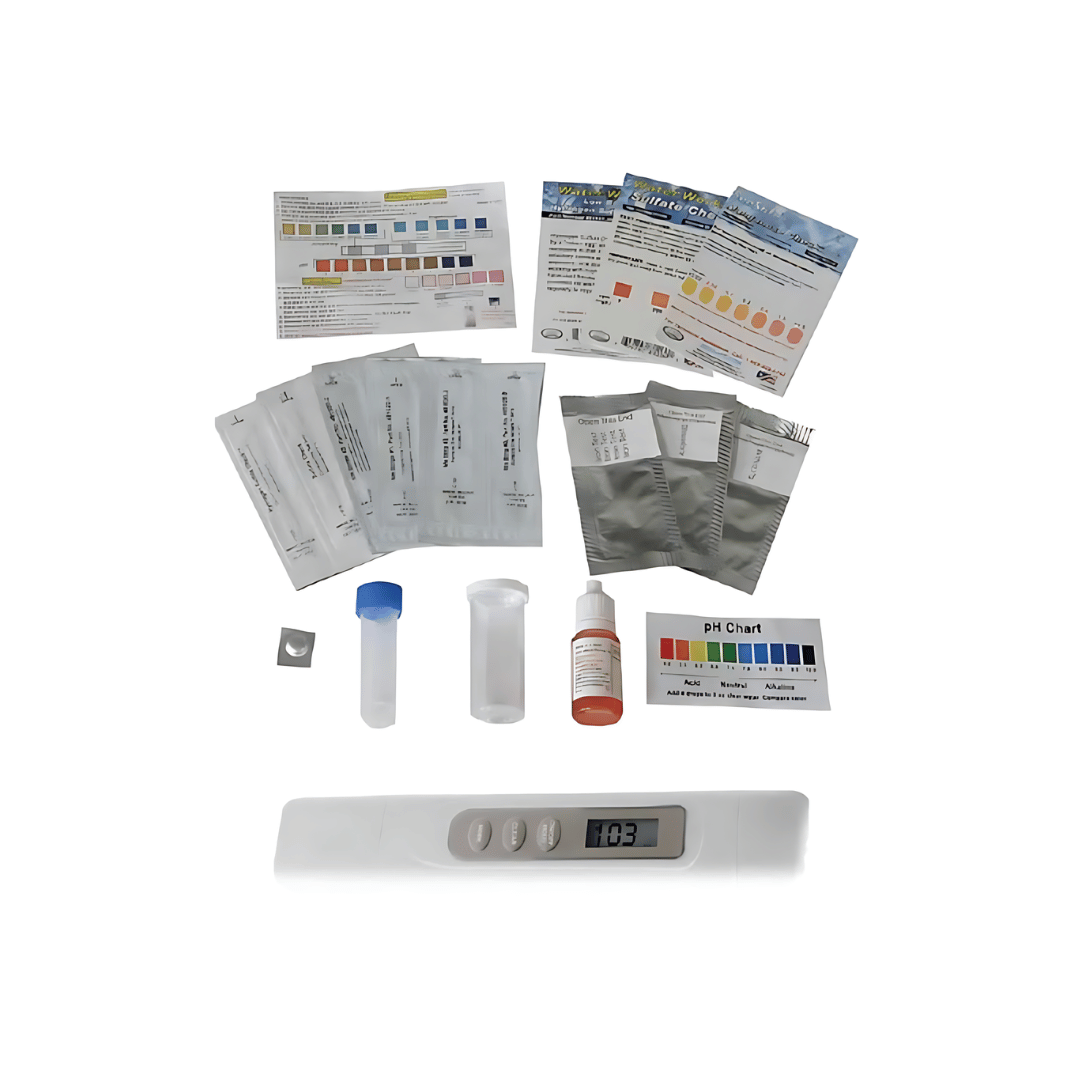
- Annual water test — Test your water once a year to confirm the system is performing as expected. pH, iron, and hardness are the key parameters to check.
Upflow System
-
- Check media levels — Without backwashing, media doesn’t redistribute itself. Check levels once or twice a year and top off as needed.
- Watch for sediment buildup — If you notice a drop in flow or pressure, sediment may be accumulating. A manual flush can help clear it.
- Annual water test — Test once a year to confirm the system is hitting its targets.
How Much Water Does Backwashing Use?
A fair question. A typical backwash cycle on a whole house system uses approximately 50–75 gallons of water depending on tank size and cycle length. At twice a week that’s roughly 100–150 gallons per week — comparable to a couple of extra loads of laundry. For most households on a well that’s not a significant concern. For city water customers on metered billing it’s worth factoring in, but the volume is modest relative to total household use.
Frequently Asked Questions About Backwashing
During backwashing the system is in cleaning mode, not filtration mode. Using water during the cycle can interrupt the backwash. That’s why scheduling it at 2am when nobody is using water is standard practice. Most cycles complete in 15–20 minutes total.
The easiest check is water pressure — if your pressure is consistent and your water quality is where it should be, the system is working. You can also watch your drain line during a scheduled cycle to confirm water is flowing through it. The 5900-BT Bluetooth app shows cycle history and any error alerts.
First check that the time on the control head is set correctly — if the clock has lost power and reset to 12:00 it may be triggering at the wrong time. Also confirm the backwash day and frequency settings. If the valve isn’t moving at all, a standard rebuild kit with fresh seals usually resolves it. Call us at 888-600-5426 and we’ll walk you through it.
Carbon media in a properly backwashing whole house filter typically lasts 5–10 years. Calcite in an acid neutralizer dissolves gradually and needs topping off once or twice a year — it doesn’t need full replacement, just replenishment. Greensand and specialty media have their own service life depending on water conditions.
Frequently Asked Questions About Backwashing Maintenance
For routine maintenance — checking the pre-filter, topping off media, confirming the backwash schedule — no. Most homeowners handle this themselves with no special tools or skills. If the control valve ever needs a rebuild, any licensed plumber can do it, or we can advise you.
The 7500 Rev 4 is a non-Bluetooth backwashing control valve that uses a high-tech ceramic disc design rather than a piston-and-seal. The ceramic disc is extremely durable — rated for over 150,000 backwash cycles — and requires no O-rings or gaskets. It backwashes on a time-based schedule (by day of week) or by gallons used via a built-in flow sensor. Default backwash time is set for 10 minutes at 2:00am, with an 8-minute fast rinse cycle to follow. It’s programmable and includes automatic recall after a power outage so your schedule isn’t lost. The 7500 Rev 4 is a solid, long-lasting valve — if you have one it will continue to serve you well.
Time-based backwashing runs the cleaning cycle on a fixed schedule — for example every Monday and Thursday at 2am regardless of how much water you’ve used. Demand-based backwashing, available on some control valves including the 7500 Rev 4, uses a built-in flow sensor to track actual water usage and only triggers a backwash when a set number of gallons has passed through the system. Demand-based can save water in lower-usage households. For most residential applications time-based is simpler to set and works perfectly well.
Related Articles From Our Blog
Acid Neutralizer Filters — Raise pH and Protect Your Plumbing — How calcite media works, which system to choose, and how backwashing keeps your neutralizer running right.
What Are the Top-Rated Water Filtration Systems for Well Water? — The full breakdown of well water treatment options from iron filters to UV systems.
Custom Water Filtration Based on Your Water Test Results — Why testing first is always the right move before choosing any system.
How Do Well Water Pump and Pressure Systems Work? — Understanding your pressure system ensures your filter is sized and installed correctly.
Best Budget-Friendly Whole House Water Filtration Systems — Side-by-side brand comparison under $2,500.
Authoritative Resources
These government and university sources provide independent technical information on water filtration, media maintenance, and home water treatment:
EPA — Overview of Drinking Water Treatment Technologies
The EPA’s technical overview of GAC carbon media, how it works, when it exhausts, and what replacement involves. Good background on the science behind whole house carbon filtration.
EPA — Filter Backwash Recycling Rule Documents
EPA guidance on how backwashing works in water treatment systems, why it matters for water safety, and how filter media is maintained through the backwash process.
Penn State Extension — Maintenance and Treatment of Residential Water Systems
University-level guidance for homeowners on maintaining private water systems — covers filtration, disinfection, and why proper maintenance of home treatment equipment is essential for water safety.
Penn State Extension — Testing and Interpreting Residential Water Results
How to test your water before and after installing a filtration system, and how to interpret results to confirm your system is performing correctly. Covers whole house filters, acid neutralizers, and more.

Article last updated June 2026.


