_2.png)
 Request a Call
J-PRO 38 vs. Stenner vs. J-PRO 22: Which Chemical Injection Pump Is Right for Your Well?

Last updated: June 16, 2026
J-PRO 38 vs. Stenner vs. J-PRO 22: Which Chemical Injection Pump Is Right for Your Well?
If you’re shopping for a chemical injection pump for well water — or weighing a diaphragm pump against a Stenner peristaltic pump — this article walks through how the J-PRO 38 works, how it compares to a Stenner, and how it improves on the J-PRO 22. Whether you buy from us or not, our goal is to give you enough information to make the right call for your water, your home, and your budget.
What Does a Chemical Injection Pump Actually Do?
A chemical metering pump draws a precise, adjustable volume of solution — chlorine, hydrogen peroxide, soda ash, or another treatment — from a solution tank and injects it into your water line on every pump cycle. It’s the engine of any injection-based water treatment system.
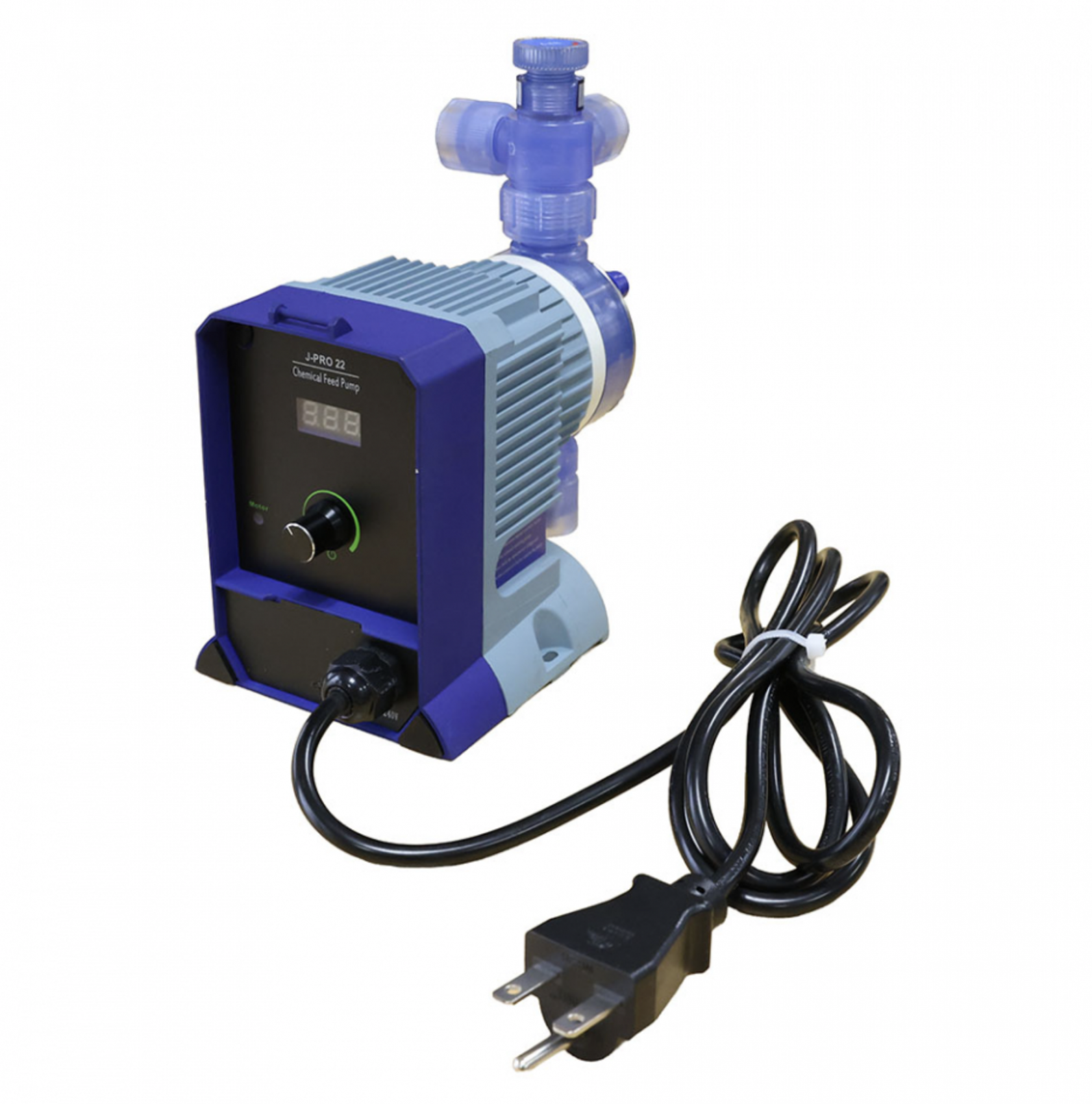
For well water, this is one of the most effective ways to treat iron, sulfur, bacteria, and low pH. The pump runs in sync with your well pump (or off a flow sensor), so chemical is injected only when water is actually flowing. That gives you consistent, proportional treatment no matter how much water you use.
Get the dosing right and a well-maintained system runs for years with minimal attention. Use an underpowered or poorly suited pump and you’ll be troubleshooting constantly.
What’s New in the J-PRO 38?
The “38” refers to its maximum output — 38 gallons per day, up from 22 on the J-PRO 22 — but the more important changes are under the hood. Each one came directly from what we learned running the J-PRO 22 in the field for years.
Dedicated voltage versions. The J-PRO 38 ships in separate 110V and 220V versions. The J-PRO 22 was dual-voltage — one pump that ran on either supply — which simplified ordering but added electrical complexity. Building a dedicated version for each voltage lets us optimize the electronics for one job instead of two.
Internal fuse protection. This is the single biggest improvement. The J-PRO 38 includes an internal, replaceable fuse that shields the control board from surges and other electrical events. On a pump without a fuse, a surge that reaches the board can take out the whole board. On the J-PRO 38, that same event often means swapping a fuse in minutes instead of replacing the board.
Proportional feed on every unit. This is one of the most practical upgrades for well water owners. The J-PRO 22 came as two separate pumps — a manual-feed model and a proportional-feed model — so moving from manual to proportional meant buying a different pump entirely. Every J-PRO 38 is proportional-feed ready out of the box. Run it manually now, and switch to proportional (flow-paced) dosing later without replacing the pump. For customers who want the ability to upgrade their dosing method down the road, this is a significant advantage.

Easier priming. Both pumps have a built-in priming valve that clears air from the line at startup, but the J-PRO 38’s is improved — it primes faster and with less fuss than the J-PRO 22 and most other metering pumps. Priming is where a lot of people get stuck with a diaphragm pump, and this makes it quick.
More output headroom. Going from 22 to 38 GPD gives high-use households and proportional-feed setups more room to work. For most homes it means running the pump comfortably in its mid-range rather than at its limit, which reduces wear over time.
Top Features Compared
| Feature | J-PRO 22 | J-PRO 38 |
|---|---|---|
| Max output | 22 GPD | 38 GPD |
| Voltage | 220V (improved) | Dedicated 110V or 220V |
| Internal fuse | No | Yes — replaceable, protects control board |
| Max line pressure | 100 PSI | 100 PSI |
| Priming valve | Yes | Yes (improved, faster priming) |
| Proportional feed | Manual and proportional sold as separate pumps | Standard on every unit; upgrade anytime |
| Chemicals | Chlorine, H₂O₂, soda ash, polyphosphates | Chlorine, H₂O₂, soda ash, polyphosphates |
| Serviceable parts | Diaphragm, check valves | Diaphragm, check valves, fuse |
| Warranty | 5-year prorated | 1-year |
What About the J-PRO 22?
The J-PRO 22 is still available — we currently have 50 units in stock — and the current version has been improved. It’s now available in 220V only, with updated electronics that address issues we occasionally saw in earlier units. If you’re on a 220V installation and the J-PRO 22’s output fits your flow rate and chemical dose requirements, it’s a solid, proven pump backed by a five-year prorated warranty.
The main reason to step up to the J-PRO 38 is the built-in proportional feed on every unit and the internal fuse protection. If you want the flexibility to run proportional dosing now or in the future — without buying a second pump — the J-PRO 38 is the better long-term investment.
Maintenance Is Not Failure
Worth saying plainly: a diaphragm metering pump that needs a new diaphragm or check valve is not a failed pump. These are normal wear parts, the same way brake pads are a normal wear part on a car.
Diaphragms typically last 2 to 4 years in residential use. Check valves can foul with iron or mineral scale and need occasional cleaning or replacement. Neither is a pump dying — it’s a pump being maintained. The J-PRO 38 makes that maintenance easier by adding the fuse to the list of parts you can replace yourself, so an electrical event no longer means a new pump.
J-PRO 38 vs. Stenner Pump: An Honest Comparison
If you’re considering a diaphragm pump, it’s worth looking at a Stenner peristaltic pump too. Stenner pumps have been around since 1957, they’re widely used, and their maintenance model is refreshingly predictable. In summary, here’s how the two actually compare.

How a Stenner works
A Stenner is a peristaltic pump: it moves liquid by squeezing a flexible tube with rotating rollers. The fluid never touches the pump’s moving parts — it stays inside the tube. Therefore, Stenner pumps are simple, self-priming, and easy to service. When the tube wears out, usually once a year, you swap it in a few minutes with no tools.
How the J-PRO 38 works
The J-PRO 38 is a diaphragm pump. It uses a reciprocating diaphragm and check valves to draw and push solution in precise, adjustable strokes. For example, it runs at higher pressure than most peristaltic pumps, offers two-axis adjustment (speed and stroke) for finer dosing, and has no tube to replace on a schedule.
The real tradeoffs
| Factor | Stenner (peristaltic) | J-PRO 38 (diaphragm) |
|---|---|---|
| Ongoing maintenance | Tube swap ~annually (~$15–25) | Diaphragm every 2–4 years if needed; fuse replaceable |
| Hydrogen peroxide | Compatible; annual tube swap still applies | Compatible; no tube to replace |
| Priming | Self-priming | Fast, easy priming via built-in priming valve |
| Proportional feed | Needs a proportional-specific model or extra parts | Built in on every unit — upgrade anytime |
| Dosing precision | One adjustment | Two adjustments (speed + stroke) |
| Max pressure | ~95 PSI | 100 PSI rated |
| Chlorine durability | Tube degrades; annual swap expected | No tube; check valves and diaphragm resist chlorine |
| Surge protection | No internal fuse | Internal replaceable fuse |
| Continuous duty | Good | Built for 24-hour continuous duty |
Both pump types work well. The Stenner’s annual tube swap is cheap and straightforward, and some homeowners genuinely prefer that predictability. Therefore, if you already run a Stenner and it’s working, there’s no reason to switch.
Getting the Most Out of Your J-PRO 38
The most important thing you can do at installation — for any diaphragm pump — is add a surge protector on the outlet. Even with the internal fuse, a surge protector is cheap insurance and your first line of defense.
Beyond that:
-
- If the pump ever loses prime, use the built-in priming valve to clear the air from the line. It’s quick and needs no disassembly.
- Inspect check valves once a year. Iron and mineral scale build up on inlet and outlet check valves over time. A quick cleaning restores full flow and prevents unnecessary wear.
- Keep the pump indoors, away from freezing temperatures and direct sun. Those conditions accelerate wear and aren’t covered under warranty.
- Dilute hydrogen peroxide with distilled or RO water — not untreated well water. Minerals in well water destabilize peroxide and speed up decomposition in the tank.
- Plan for diaphragm replacement every few years. This is routine maintenance, not failure. Replacement diaphragms are available and the job is straightforward.
What the J-PRO 38 Is Best For
The J-PRO 38 covers the full range of common well water injection jobs:
-
- Chlorine injection for iron, manganese, and bacteria. Works with 1% or 5% liquid bleach or 12% liquid pool chlorine. Flow rates from 1 to 50 GPM.
- Hydrogen peroxide injection for sulfur odor, iron bacteria, and oxidation without a chlorine residual. Flow rates from 0.5 to 50 GPM.
- Soda ash injection for low-pH (acidic) water. Raises pH to protect plumbing and appliances from corrosion.
- Polyphosphate and citric acid for scale control and iron sequestration.
Already Running a J-PRO 22?
If your J-PRO 22 is working, keep running it — with a surge protector and good maintenance habits, it has plenty of life left. The J-PRO 38 uses the same installation footprint and connections, so when you’re ready to upgrade it’s a direct fit with your existing solution tank, injection check valve, and tubing. Just be sure to order the correct voltage, since the J-PRO 38 comes in dedicated 110V and 220V versions.
Furthermore, if your J-PRO 22 has failed or is acting up, reach out. Every J-PRO 22 carries a five-year prorated warranty, and we’re also running a trade-in program for owners who want to move up to the J-PRO 38.
Contact us at support@cleanwaterstore.com, Monday through Friday, 7:30 AM to 3:30 PM PT.

Frequently Asked Questions
Is the J-PRO 38 a direct replacement for the J-PRO 22?
Yes. It uses the same installation footprint and connections and works with existing solution tanks, injection check valves, and tubing. Order the correct voltage — the J-PRO 38 comes in dedicated 110V and 220V versions.
Is the J-PRO 22 still available?
Yes. The J-PRO 22 is still sold and in stock in an improved 220V version. It’s a solid choice for 220V installations where the output capacity fits your application. The main advantage of stepping up to the J-PRO 38 is the built-in proportional feed on every unit and the internal fuse protection.
Can the J-PRO 38 inject hydrogen peroxide?
Yes. Both the J-PRO 38 and J-PRO 22 are compatible with hydrogen peroxide injection. The J-PRO 38’s built-in priming valve makes it easy to clear air from the line at startup, and its diaphragm and check valves are built to handle the full range of common well water treatment chemicals.
Can I switch the J-PRO 38 from manual to proportional feed later?
Yes — and this is one of the J-PRO 38’s biggest practical advantages. In fact, every unit is proportional-feed ready out of the box, so you can start running it manually now and switch to flow-paced dosing later without replacing the pump. The J-PRO 22 sold manual and proportional as separate pumps, so switching meant buying a new unit. A standard Stenner also needs a proportional-specific model or extra parts to do the same.
What is the internal fuse and why does it matter?
It’s a replaceable fuse that protects the control board from surges and other electrical events. On a pump without one, a surge can destroy the board; on the J-PRO 38, you often just replace the fuse. However, we still recommend a surge protector at the outlet as your first line of defense.
How long should the J-PRO 38 last?
You can run the pump body for many years of service with proper installation and maintenance. The diaphragm and check valves are normal wear parts with a typical 2-to-4-year life, replaceable without replacing the pump.
Is a Stenner a better choice for hydrogen peroxide?
The Stenner is a well-regarded pump and a legitimate choice for hydrogen peroxide injection. Both pump types handle H₂O₂ reliably. The J-PRO 38 has no tube to replace on any schedule, and its built-in proportional feed makes it easier to dial in precise dosing for peroxide applications.
Related resources
Hydrogen Peroxide Well Water Systems — Clean Water Store
Chlorination Systems for Well Water — Clean Water Store
Iron Bacteria in Well Water: Water Test
Soda Ash Injection for Acid Well Water — Clean Water Store


