_2.png)
 Request a Call
What Are PFAS Forever Chemicals and Are They in My Water? Everything Homeowners Need to Know
PFAS — per- and polyfluoroalkyl substances — have become one of the most talked-about drinking water concerns in the country. Whether you’re on city water or a private well, in a rural community or a major metro area, the chances are real that PFAS forever chemicals in drinking water could be a concern for you. Here at Clean Water Store, we get questions about PFAS every day. Below are the most important questions homeowners are asking — with straight answers, and honest guidance on what you can do about it. Regardless if you buy from us, having the facts will help you protect your family from this rising concern.

What Are PFAS and Why Are They Called Forever Chemicals?
PFAS is a broad group of more than 12,000 man-made chemicals that have been used in manufacturing and consumer products since the 1940s. They’re found in nonstick cookware, food packaging, firefighting foam, waterproof clothing, stain-resistant carpets, and hundreds of industrial applications.
The reason they’re called “forever chemicals” is alarming but simple — the carbon-fluorine bond that makes PFAS so useful industrially is one of the strongest bonds in chemistry. PFAS do not break down naturally in the environment or in the human body. They accumulate over time in soil, water, and living tissue. They’ve been detected in the blood of people all over the world, including in remote communities far from industrial activity.

Are PFAS Dangerous to My Health?
Research into PFAS health effects is ongoing, but the evidence gathered so far is serious enough that federal and state regulators have moved aggressively to set new limits. Studies have linked long-term PFAS exposure to increased risk of certain health problems. These include kidney and testicular cancer, thyroid disease, immune system disruption, hormone and reproductive issues, high cholesterol, and developmental problems in children and infants.
In 2024 the U.S. Environmental Protection Agency finalized the first-ever federal maximum contaminant levels for six PFAS compounds in drinking water. The limit set for PFOA and PFOS is only 4 parts per trillion. A number near the lowest detectable level with current technology. This is a strong signal from regulators about how seriously PFAS contamination is taken.
Is PFAS Contamination a City Water Problem or a Well Water Problem?
It is both — and this is one of the most important things homeowners need to understand. City water customers are not automatically protected. Municipal water systems source their water from surface water and groundwater. Both of which can be contaminated with PFAS from industrial discharge, military base runoff, landfill leachate, and other sources.
While municipal systems are now required to test for PFAS and will face compliance deadlines under the new EPA rules, many systems are still working through that process. Private well owners face a different challenge — their water is not regulated or tested by any government agency, meaning PFAS contamination can go undetected for years without proactive testing.
Where in the United States Is PFAS Contamination Most Common?
PFAS contamination has been detected in all 50 states, but certain regions and situations carry higher risk. Areas near military bases and airports where AFFF firefighting foam was used — including parts of Michigan, New York, Colorado, North Carolina, and California — have seen some of the most severe contamination.
Industrial corridors in the Midwest and Southeast, particularly near chemical manufacturing plants, have elevated PFAS levels. Agricultural areas where PFAS-containing biosolids were used as fertilizer — common in parts of Maine, Michigan, and the Pacific Northwest — have seen PFAS migrate into well water.
Lastly, coastal communities in states like Massachusetts, New Jersey, and Washington have also documented contamination. If you live near a military installation, airport, industrial site, or agricultural land where biosolids were applied, your risk is higher — whether you’re on city water or a private well.
How Do I Know if PFAS Are in My Water?
The only way to know for certain is to test your water. City water customers can check their municipality’s annual Consumer Confidence Report. This will increasingly include PFAS data under new EPA rules. However, for the most current and complete picture, an independent test is always best.
Well water customers have no regulatory safety net and should test proactively, especially if they live in a higher-risk area. We offer the SimpleLab PFAS Water Test — a comprehensive lab-certified test. This test screens for a broad panel of PFAS compounds and gives you clear, actionable results. It’s an easy mail-in process, and knowing what’s in your water is the most important first step.

Can a Whole House Filter Remove PFAS From My Water?
Yes — and whole house filtration is the most comprehensive solution for PFAS because it protects every tap, shower, and appliance in your home. PFAS can be absorbed through skin contact and inhaled as steam during showers, so point-of-use filters at the kitchen tap alone don’t provide complete protection.
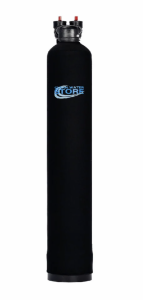
Our PFAS High-Capacity Removal Filter System is a whole-home solution designed specifically for PFAS reduction. It uses high-capacity media to address a broad spectrum of PFAS compounds throughout the entire home. It’s an ideal solution for both city water and well water homeowners who want comprehensive protection. Going beyond just one tap, to everywhere water enters their home.
What Is the PFAS High-Capacity Removal Filter System and How Does It Work?
Our PFAS High-Capacity Removal Filter System is a whole-home backwashing filter system designed for high-volume PFAS reduction. It installs at the point of entry, where water enters your home. This way, every tap, shower, bathtub, washing machine, and appliance receives treated water. The system uses specially engineered high-capacity filter media that is highly effective at capturing a wide range of PFAS compounds. It is available in multiple sizes to match your household flow rate and water usage. For well water homeowners with multiple water quality issues, it pairs seamlessly with iron filters, acid neutralizers, water softeners, and UV disinfection as part of a complete multi-stage treatment system.
Do I Need a Whole House PFAS Filter if I Already Have a Reverse Osmosis System?
A reverse osmosis system at the kitchen sink does an excellent job of reducing PFAS in your drinking and cooking water. We often recommend one as part of a complete water treatment plan. However, an RO system only treats water at one point of use.
PFAS exposure doesn’t only happen through drinking water. Research suggests that dermal absorption during bathing and inhalation of PFAS-containing steam during hot showers may contribute to body burden. For homeowners in higher-risk areas or with confirmed PFAS contamination, a whole house system provides a level of protection that a kitchen RO system simply cannot match on its own. The two systems work best together — the whole house system handles all water entry points, and the RO system provides an additional layer of purification for drinking and cooking.
Is the Pioneer System an Option for PFAS Removal?
Yes. We also carry the Pioneer Lead, PFOA/PFOS, and Cyst Point-of-Entry Water Filtration System, which is a whole-home filtration system that addresses PFAS alongside lead and cysts. The Pioneer is a strong option for homeowners who want a certified point-of-entry system with broad-spectrum contaminant reduction. That said, for homeowners with confirmed or suspected high PFAS levels, our high-capacity PFAS removal filter system is our primary recommendation for maximum whole-home protection.
How Do I Get Started Protecting My Home From PFAS?
We recommend three steps. First, test your water with our SimpleLab PFAS Water Test so you know exactly what you’re dealing with. Second, review your results — our team of water treatment experts is happy to help you understand what your results mean. From there, we will help you know what level of treatment is appropriate for your situation.
Third, choose the right system for your home. Whether that is one filter, or a combination of systems to get the best water quality.

Our Learning Center exists to help you make the right call for your family’s water. Every recommendation is backed by our experienced team because we believe an informed homeowner makes the best decision.
Shop the PFAS High-Capacity Removal Filter System →

Resources
PFAS research is evolving rapidly. Here are five trusted government and university sources to help you stay informed.
- U.S. EPA — PFAS Per- and Polyfluoroalkyl Substances
The EPA’s comprehensive PFAS resource hub, including the 2024 National Primary Drinking Water Regulation for PFAS, health advisories, and cleanup efforts nationwide. - CDC/ATSDR — PFAS and Your Health
The Agency for Toxic Substances and Disease Registry’s resource on PFAS health effects, exposure pathways, and what communities can do to reduce risk. - National Institutes of Health (NIH) — PFAS Health Effects
NIH research on the health impacts of PFAS exposure, including cancer risk, immune function, and developmental effects in children. - USGS — PFAS in Water Resources
The U.S. Geological Survey’s research on PFAS occurrence in groundwater, surface water, and drinking water sources across the United States. - Penn State Extension — PFAS in Private Water Supplies
University-backed guidance specifically for private well owners on PFAS testing, health risks, and treatment options.
All product information reflects current Clean Water Store offerings and is subject to change. Contact us for personalized recommendations based on your water test results.


