_2.png)
 Request a Call
Carbon Backwash Filter for City Water: What It Does, What It Doesn’t, and How to Size It
If you are on city water and dealing with chlorine taste and odor, chemical smell in the shower, dry skin, or just water that doesn’t taste the way it should, a whole house carbon backwash filter is almost certainly the right first step.

Article last updated July 15, 2026 by Author.
But there are real differences between filter types, media choices, and sizing that determine whether the system actually solves your problem. This guide covers everything to know before choosing the right whole house filter.
Why City Water Has Chlorine — and Why That Matters for Filtration
Municipal water systems add chlorine or chloramine to disinfect drinking water before it reaches your home. This is required by federal regulations and is genuinely important for public health. Chlorination has virtually eliminated waterborne diseases that were common before the 20th century.
But the same chemical properties that make chlorine an effective disinfectant also make it hard on skin, hair, and appliances. Chlorine can strip natural oils from skin and hair, contribute to dryness and irritation, degrade rubber seals and softener resin, and react with organic matter in water to form disinfection byproducts. These include trihalomethanes (THMs) and haloacetic acids (HAAs). Both are regulated by the EPA because of their long-term health implications.
The solution is not to wish your city used less chlorine. The solution is to remove it at the point where water enters your home, before it reaches your taps, showers, and appliances.
Chlorine vs. Chloramine: Why the Distinction Matters
This is the most important thing to check before buying any whole house carbon filter for city water.
According to the EPA, more than one in five Americans receive drinking water treated with chloramines — a combination of chlorine and ammonia — rather than standard chlorine. Utilities increasingly use chloramines because they are more stable in the distribution system, travel further in pipes without dissipating, and produce lower levels of some regulated disinfection byproducts.
The problem: chloramine is significantly harder to remove than standard chlorine. Standard granular activated carbon (GAC) does not remove chloramines effectively at whole-house flow rates. It would require impractically long contact time to break down chloramine with standard carbon.
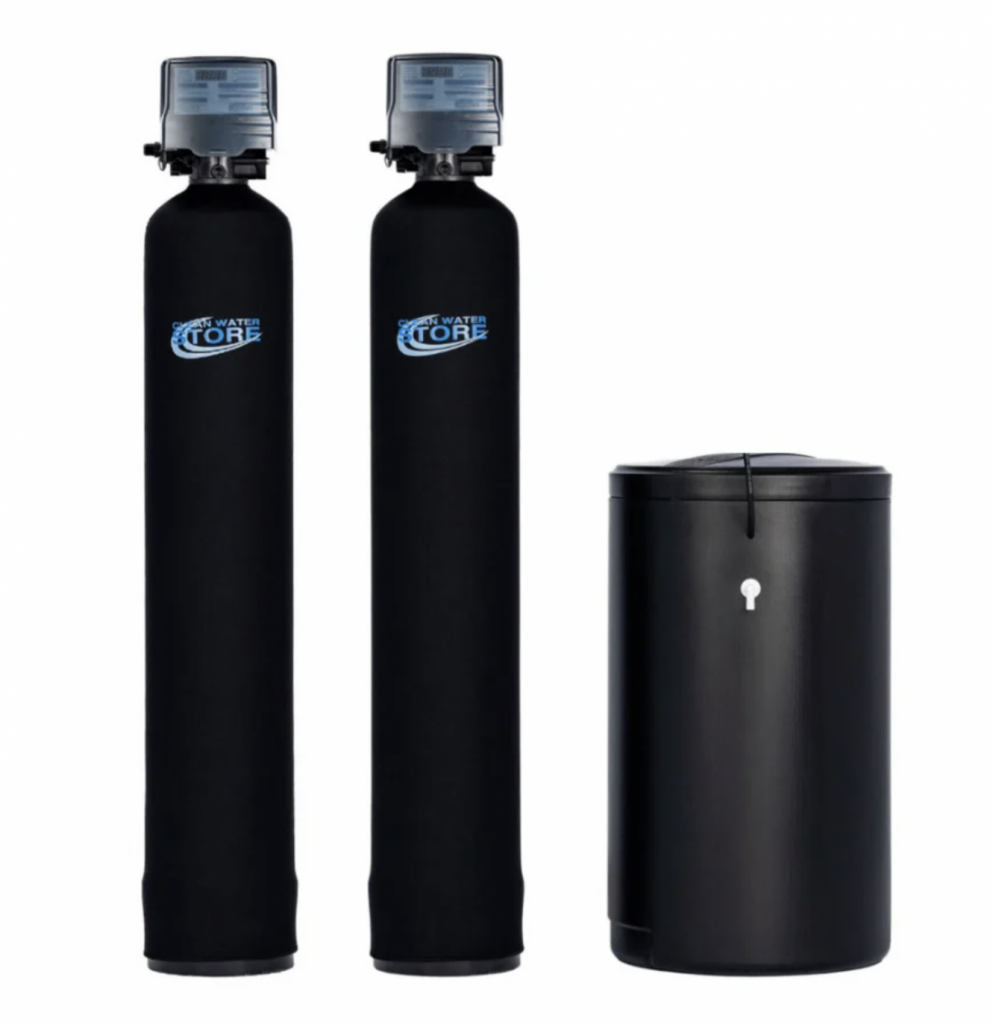
Catalytic carbon is the correct media for chloramine removal. It has a specially modified surface structure that catalyzes the decomposition of chloramine molecules, breaking them down without requiring the extended contact time that standard carbon needs.
How to find out which disinfectant your city uses: Pull your annual Consumer Confidence Report (CCR) from your water utility’s website. The EPA requires all public water systems to publish one annually. Search the document for “disinfectant” or “chloramine.” If your city uses chloramine, it will be listed. If you cannot find your CCR, call your utility directly.
Carbon Backwash Filter vs. Carbon Cartridge Filter: Which One Do You Need?
This is the most common question from city water customers comparing options, and the answer is almost always the same: for whole-house city water treatment, a backwash filter is the better long-term investment.
Carbon Backwash Filter
A backwash filter is a large tank, typically 9 to 13 inches in diameter and 48 to 54 inches tall and filled with granular activated carbon media and controlled by an automatic valve. During normal operation, water flows down through the carbon bed, where chlorine and other contaminants are adsorbed onto the carbon surface. Periodically, typically at 2 AM when no one is using water, the valve reverses flow direction and backwashes the media, flushing trapped sediment out to the drain and reclassifying the carbon bed.
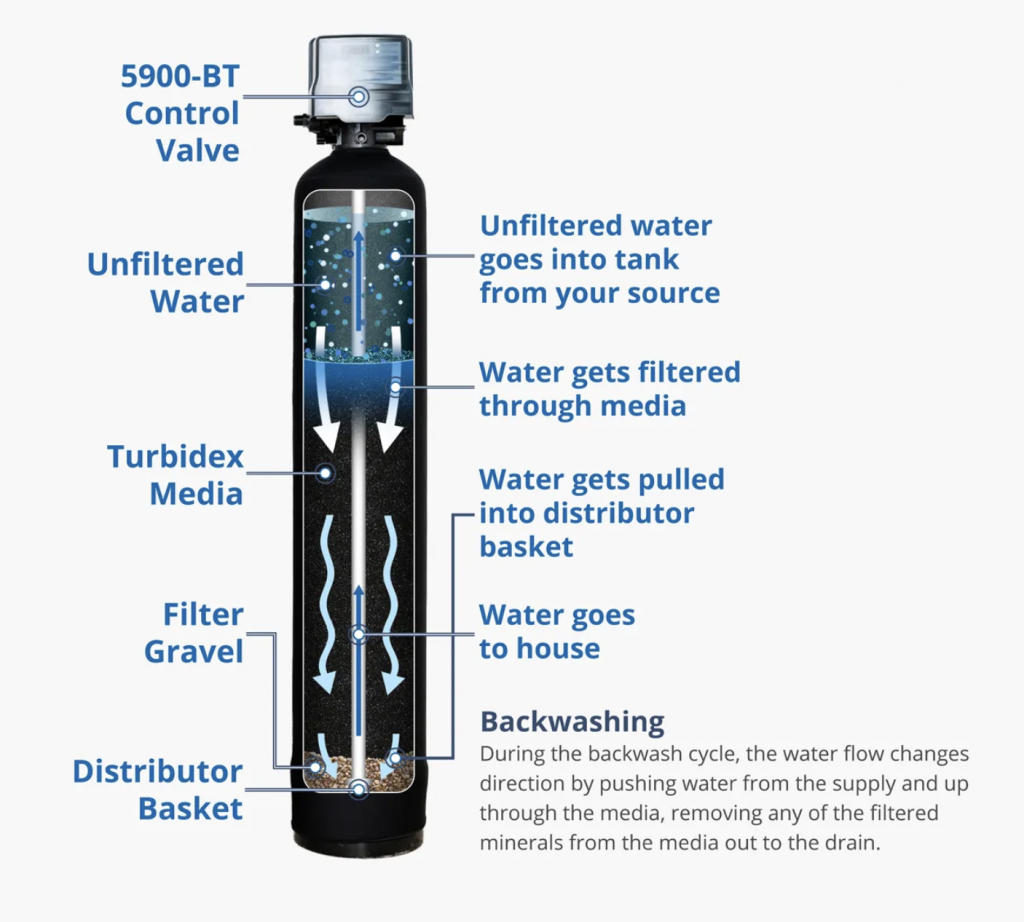
Key advantages:
-
- Handles whole-house flow rates (8 to 15+ GPM) without pressure drop
- Self-cleaning — no cartridges to change regularly
- Media lasts 4 to 6 years before replacement
- Much lower operating cost than cartridge filters over time
- The 7500 model uses a ceramic disc valve rated for 150,000+ backwash cycles — significantly more durable than standard piston-type valves
Carbon Cartridge Filter
A cartridge filter uses a replaceable carbon block or GAC cartridge housed in a filter canister. It is lower cost upfront, easier to install, and requires no drain connection for backwashing.
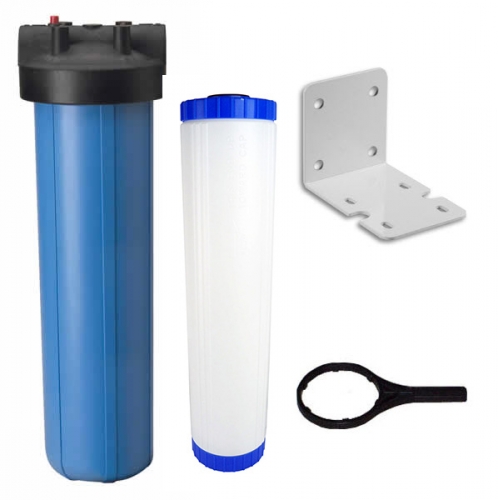
Where cartridge filters make sense:
-
- Small households with one bathroom and low water usage
- Renters or situations where a permanent tank installation is not practical
- As a supplemental final stage after a backwash system
- Budget-constrained situations where upfront cost is the primary constraint
Where cartridge filters fall short:
-
- Cartridges must be replaced every 6 months — at $30 to $80+ each, this adds up fast
- At whole-house flow rates, cartridges can restrict pressure
- Capacity is limited — high chlorine or high usage exhausts cartridges quickly
Not sure which carbon filter is right for your city water?
Our WQA-certified specialists review your CCR and water situation and help you choose the right system and media for your home — at no charge.
How to Size a Carbon Backwash Filter for Your Home
Undersizing is the most common mistake. An undersized system creates pressure drop throughout the house and exhausts media faster because more chlorine contact is concentrated on less carbon surface area.
The two key sizing factors:
1. Flow rate (GPM) — How much water your home uses at peak demand. A house with 1 to 2 bathrooms typically needs 8 to 10 GPM. A home with 3 bathrooms needs 10 to 12 GPM. Larger homes may need 15 GPM or more. If you are not sure, measure: time how long it takes to fill a 5-gallon bucket at a hose bib. Divide 5 by the seconds, multiply by 60. That is your approximate GPM.
2. Carbon volume (cubic feet) — More carbon means more contact time and longer media life. For a standard 2 to 3 bathroom home on city water with typical chlorine levels, a 1.5 cubic foot system is the minimum. For higher chlorine levels, chloramine, or larger homes, 2.0 cubic feet or larger is recommended.
The 7500 carbon backwash systems are available in 1.0, 1.5, and 2.0 cubic foot configurations. The 5900-BT uses a demand-initiated valve that backwashes based on water usage rather than a fixed timer — using less water and salt while adapting automatically to your household’s usage patterns.
What a Carbon Backwash Filter Does NOT Remove
This is just as important as knowing what it does remove. A carbon backwash filter is the right solution for chlorine, chloramine, taste, odor, and many organic compounds. It is not the right solution for:
-
- Hardness — calcium and magnesium pass straight through carbon. You need a water softener added for hardness.
- Lead and heavy metals — dissolved lead from pipes is not significantly reduced by standard carbon at whole-house flow rates. A point-of-use RO system at the kitchen tap is the right solution for lead or see our whole house PFAS and lead reduction system.
- Nitrates — require RO or ion exchange specifically designed for nitrate removal.
- PFAS — standard carbon has limited PFAS removal. High-capacity catalytic carbon systems can reduce some PFAS, but an under-sink RO is more reliable for drinking water PFAS concerns.
- Bacteria — carbon does not disinfect. If your city issues a boil water advisory or you have concerns about biological contamination, a UV system is required as an additional stage.
Where the Carbon Filter Goes in Your System
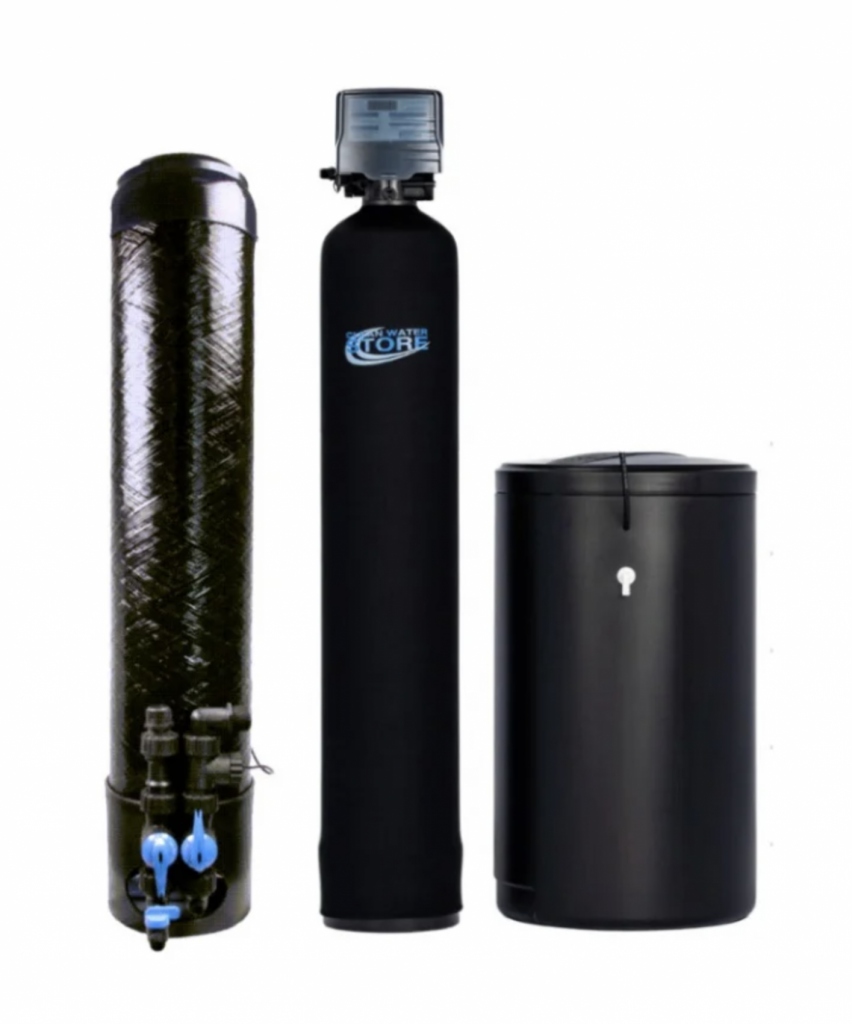
Installation location matters. For city water, the carbon backwash filter installs at the point of entry, where the main water line enters the home. This way, it treats all water before it reaches any fixture or appliance.
If you are also installing a water softener: The carbon filter must go first. Chlorine and chloramine in city water degrade softener resin, reducing ion exchange capacity over time and shortening the softener’s life. Installing the carbon filter upstream protects the resin.
The correct order for city water: Carbon backwash filter → Water softener → All fixtures and appliances.
For a complete city water solution, see our Whole House Filtration and Softening Bundles — pre-configured systems that include both components correctly sized and matched.
How Long Will the Carbon Media Last?
In a typical residential city water application, GAC media lasts 4 to 6 years before needing replacement. Catalytic carbon generally lasts slightly longer because the catalytic reaction does not consume the carbon surface the way chlorine adsorption does.
The simplest way to know when it is time: test your tap water for chlorine with a simple test strip. If chlorine is detectable after your filter, the media is exhausted and needs replacement. Media replacement is straightforward — no special tools required — and costs $100 to $300 depending on system size.
The Bottom Line
For most city water homeowners dealing with chlorine taste, chemical odors, dry skin, or concerns about disinfection byproducts, a whole house carbon backwash filter with the correct media is the right first system. The key decisions are whether your city uses chloramine (catalytic carbon) or standard chlorine (GAC), and whether you also have hardness that requires a softener downstream.
Start by pulling your CCR. If you need help reading it or sizing a system for your home, our team reviews CCRs every day and helps homeowners make the right choice for their specific water and their home.
Ready to remove chlorine from your city water?
Schedule a free call with one of our WQA-certified water specialists. We will review your CCR and help you choose the right system for your home.
Related Resources
Sources & Further Reading


