_2.png)
 Request a Call
Does My Water Filter Actually Remove Microplastics?
You’ve probably read that microplastics are showing up in drinking water. What most people don’t know is whether the filter they already have — or the one they’re thinking about buying — is actually doing anything about it. You might be wondering, “does my water filter remove microplastics,” and if your drinking water is truly safe.
The answer depends entirely on one thing: micron size. And most filter marketing doesn’t explain this clearly enough to be useful.
Gerry Bulfin of Clean Water Store breaks it down in the video below in a straightforward explanation of what each filtration technology actually catches and where each one falls short.
What Are Microplastics and Nanoplastics?
Microplastics are plastic particles smaller than 5 millimeters. They come from the breakdown of larger plastic items, synthetic fabrics, packaging, and industrial processes. Nanoplastics are an even smaller subset — particles below 1 micron — that can pass through barriers that catch larger microplastics.
Both have been confirmed in tap water, well water, and groundwater worldwide. If you want to understand more about how they get into your water supply specifically, we’ve covered that in detail:
- 👉 Are Microplastics in Your City Water? What the Research Shows and How to Filter Them
- 👉 Are Microplastics in Well Water? What Private Well Owners Need to Know
This article focuses on the next question: once you know they’re there, does your filter actually catch them?
What Does Micron Size Actually Mean?
A micron is one millionth of a meter. The smaller the micron rating on a filter, the smaller the particles it can catch — and the more effective it is against microplastics and nanoplastics.
Here’s a practical reference point: most microplastics detected in drinking water range from 1 to 100 microns in size. Nanoplastics fall below 1 micron. Your filter’s micron rating tells you exactly where its protection stops.
What Does a 1 Micron Filter Remove — and What Does It Miss?
A standard 1 micron carbon block filter — the kind commonly used as a point-of-use or whole-house pre-filter — will catch many larger microplastic particles. That’s genuinely useful, and it’s better than no filtration at all.
But a 1 micron filter has real limits. Particles smaller than 1 micron pass right through, including smaller microplastics and essentially all nanoplastics. If your only filtration is a carbon block or standard cartridge filter, you’re catching some microplastics but leaving a significant portion unaddressed.
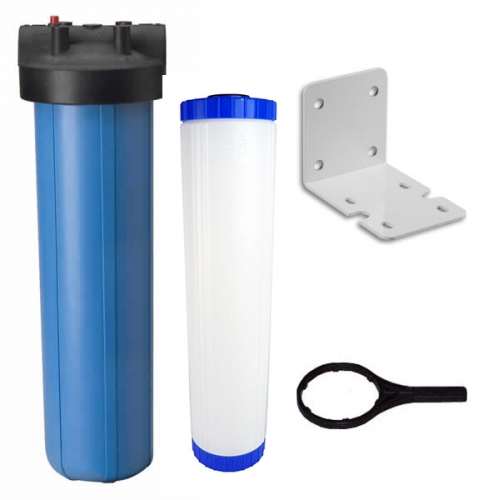
Carbon filters are still valuable — particularly for removing chlorine, chloramines, and organic compounds — but they’re not a complete solution for microplastics on their own.
How Does Ultrafiltration Remove Microplastics?
Ultrafiltration (UF) uses a hollow fiber membrane with pores around 0.01–0.02 microns. That’s 50 to 100 times smaller than a standard 1 micron filter. At that scale, UF physically blocks the vast majority of microplastics — including most of the smaller particles that a 1 micron filter passes.
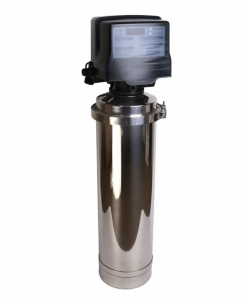
Because UF operates at whole-house scale — treating all the water that enters your home — it provides comprehensive microplastic protection for every tap, shower, appliance, and ice maker. It runs on standard line pressure, requires no electricity, produces no waste water, and preserves the dissolved minerals in your water.
For a deeper look at how UF compares to other membrane technologies, see our full guide: 👉 Ultrafiltration vs. Reverse Osmosis: Which System Do You Actually Need?
What is the Limitation of Ultrafiltration for Microplastics?
UF is excellent for microplastics but has one important limitation: nanoplastics.
Nanoplastics — particles below 0.01 microns — are small enough to pass through even a UF membrane. This is an emerging area of research, and the health implications of nanoplastic exposure are still being studied. But if you want protection against the full size range of plastic particles in your drinking water, UF alone isn’t the complete answer.
This is where reverse osmosis comes in.
Why is Reverse Osmosis the Gold Standard for Drinking Water?
A reverse osmosis membrane filters at approximately 0.0001 microns — roughly 100 times smaller than a UF membrane. At that scale, RO rejects not just microplastics and nanoplastics, but also dissolved contaminants that no physical filter can touch: nitrates, arsenic, PFAS, fluoride, heavy metals, and virtually everything else dissolved in the water.

For drinking and cooking water specifically, RO is the most comprehensive filtration technology available to homeowners. It addresses the full spectrum of plastic particles — including nanoplastics — along with the chemical contaminants that often travel alongside them.
Want to understand how PFAS and microplastics interact in your water? 👉 PFAS vs. Microplastics: What’s the Difference and Are Both in My Water?
What Is the Best Filter Setup for Microplastics in Your Home?
So if you are asking “does my water filter remove microplastics?” the practical takeaway from Gerry’s video is that most people get this wrong by treating it as a single-filter decision. The most effective approach uses layers, with each stage doing a specific job:
Stage 1 — 1 micron carbon block pre-filter Catches larger particles, sediment, and rust. Removes chlorine and organic compounds. Protects the downstream membrane from fouling.
Stage 2 — Whole-house ultrafiltration Removes the vast majority of microplastics at 0.01–0.02 microns for every tap in the home. Protects your entire household water supply including showers, appliances, and ice makers.
Stage 3 — Under-sink reverse osmosis Removes nanoplastics, PFAS, dissolved chemicals, heavy metals, nitrates, and everything else at 0.0001 microns for drinking and cooking water at the kitchen tap.
This layered approach gives you whole-house microplastic protection via UF plus the purest possible drinking water via RO — without the cost and complexity of whole-house RO.
Does This Apply to City Water and Well Water?
Yes — and the concern is real for both, though for different reasons.
City water users receive treated water, but municipal treatment is not designed to remove microplastics and currently has no regulatory standard for them. Microplastics pass through conventional treatment and arrive at your tap. The layered UF + RO setup addresses this regardless of what your treatment plant does or doesn’t catch.

Well water users face the additional challenge of no oversight or treatment whatsoever. Microplastics enter groundwater through agricultural runoff, atmospheric deposition, and surface infiltration — and no government agency is testing or treating your well on your behalf. Well water users should also address iron, manganese, and sediment upstream before any membrane system, as those contaminants will foul UF and RO membranes if not removed first.
What should you do next if you are asking does my water filter remove microplastics?
Start with a water test. Knowing what’s in your water — not just microplastics, but iron, hardness, nitrates, bacteria, and pH — tells you exactly which stages you need and in what order. That prevents overspending on the wrong system and protects your membranes from premature fouling.
If you’re not sure where to start, our team can help you figure out the right test and the right setup for your source water and situation.
Learn more:
EPA: EPA & HHS Announce Historic Actions to Protect Americans from Microplastics https://www.epa.gov/newsreleases/epa-hhs-announce-historic-actions-protect-americans-microplastics-and-safeguard
EPA: EPA Takes Bold Action to Ensure Drinking Water is Safe from Microplastics https://www.epa.gov/newsreleases/epa-takes-bold-action-ensure-drinking-water-safe-microplastics-pharmaceuticals-and
NIEHS: Understanding Exposures to Microplastics and Nanoplastics https://www.niehs.nih.gov/research/supported/translational/peph/podcasts/2024/sep24_exposures-microplastics
CDC: About Home Water Treatment Systems https://www.cdc.gov/drinking-water/about/about-home-water-treatment-systems.html

👉 Shop Water Test Kits 👉 Explore Whole House Ultrafiltration Systems 👉 Shop Reverse Osmosis Systems 👉 Contact Our Team — no commissions, no pressure, just straight answers based on your water.
Article last updated by author April 21, 2026.


