_2.png)
 Request a Call
Why a commercial size system may be the best fit for your residential water problem
What Does “Commercial-Size” Mean in Residential Water Treatment?
A commercial‑size water treatment system for a residential home refers to equipment that offers higher flow rates, larger media beds, and more robust components than standard residential systems. While most homes use 1–2 cubic foot tanks or small cartridge filters, commercial systems may use tanks 10–16 inches in diameter, high-capacity valves, and significantly larger filtration media volumes.
In real‑world terms, “commercial” doesn’t mean “industrial factory”—it simply means “built to handle bigger loads, higher performance, and tougher water conditions.” Many homeowners with complicated water issues benefit from this extra horsepower.
When Does a Standard Residential System Fall Short?
Residential systems are optimized for typical city water or mild well-water issues. They can struggle when:
-
- Flow demand is high (large households, multi-bathroom homes, simultaneous shower/laundry use).
- Water conditions are severe (high iron, manganese, sediment, tannins, sulfur, or very hard water).
- You have a large property or accessory buildings that pull water at the same time.
- There are peak-use events, like irrigation, guests, vacation rental turnover, or livestock watering.

When a residential system is undersized, the homeowner sees symptoms like pressure drops, reduced flow, poor filtration, clogging, and rapid media exhaustion.
How Can a Commercial-Size System Improve Your Home’s Water Quality?
Oversizing isn’t “overkill” — it enables the system to work more efficiently and more consistently. A commercial system can help by:
-
- Reducing pressure loss: More media surface area = smooth, stable flow.
- Increasing contact time: Larger tanks give contaminants more time to be removed.
- Delivering higher peak flow: No more water “starving” during multiple simultaneous uses.
- Lasting longer between backwashes: Larger systems maintain performance with fewer cycles.
- Handling complex contaminants better: Iron, sulfur, and heavy sediment are removed more reliably.
The result is clearer, better-tasting, odor-free water without the frustration of stressing the system.
Learn more about how to increase water pressure from a well or utility pipeline at Well Owner.
Are Commercial Systems More Reliable Than Residential Ones?
Yes, they often are. Commercial systems tend to use upgraded valves, motors, and control heads designed for durability. For homes on wells, in rural areas, or with seasonal heavy usage, this reliability matters.
Because the equipment operates below its maximum output most of the time, the components experience less wear and tear. This can extend lifespan and reduce maintenance costs.
Will a Commercial-Size System Cost More?
Upfront, yes—larger tanks and valves cost more than residential models. But homeowners often choose commercial-size systems because:
-
- They avoid premature replacement of undersized systems.
- They require fewer service calls.
- They extend the life of appliances like water heaters, dishwashers, and plumbing fixtures.
- They operate more efficiently over time (especially for iron or sulfur-heavy wells).
When a residential system struggles, the ongoing costs of fixing problems often exceed the one-time upgrade to a properly sized commercial unit.
Is a Commercial System Overkill for Most Homes?
Not necessarily. Many homes today, especially in rural areas or with custom builds, use more water than older residential sizing charts assume. Factors that often justify a commercial-size system include:
-
- 3+ bathrooms
- Large families or frequent visitors
- Multiple simultaneous uses (shower + laundry + dishwasher)
- Accessory dwelling units
- Irrigation or landscaping water tied into the same treatment line
- High iron/sulfur well conditions
- Home offices or workshops requiring water
A professional water analysis and flow test often show that what looks like a “normal home” actually has commercial-level needs.

How Do You Know If a Commercial System Is Right for Your Water Problem?
You don’t need to guess. The decision comes down to three things:
-
- Your water chemistry (iron, hardness, sulfur, TDS, pH, sediment load).
- Your peak flow rate (the most water your home uses at once).
- Your long-term needs (future-proofing for remodels or expanding household use).
If your analysis shows high contaminant levels or high flow demand, a commercial-size system is often the correct—and most cost-effective—solution.
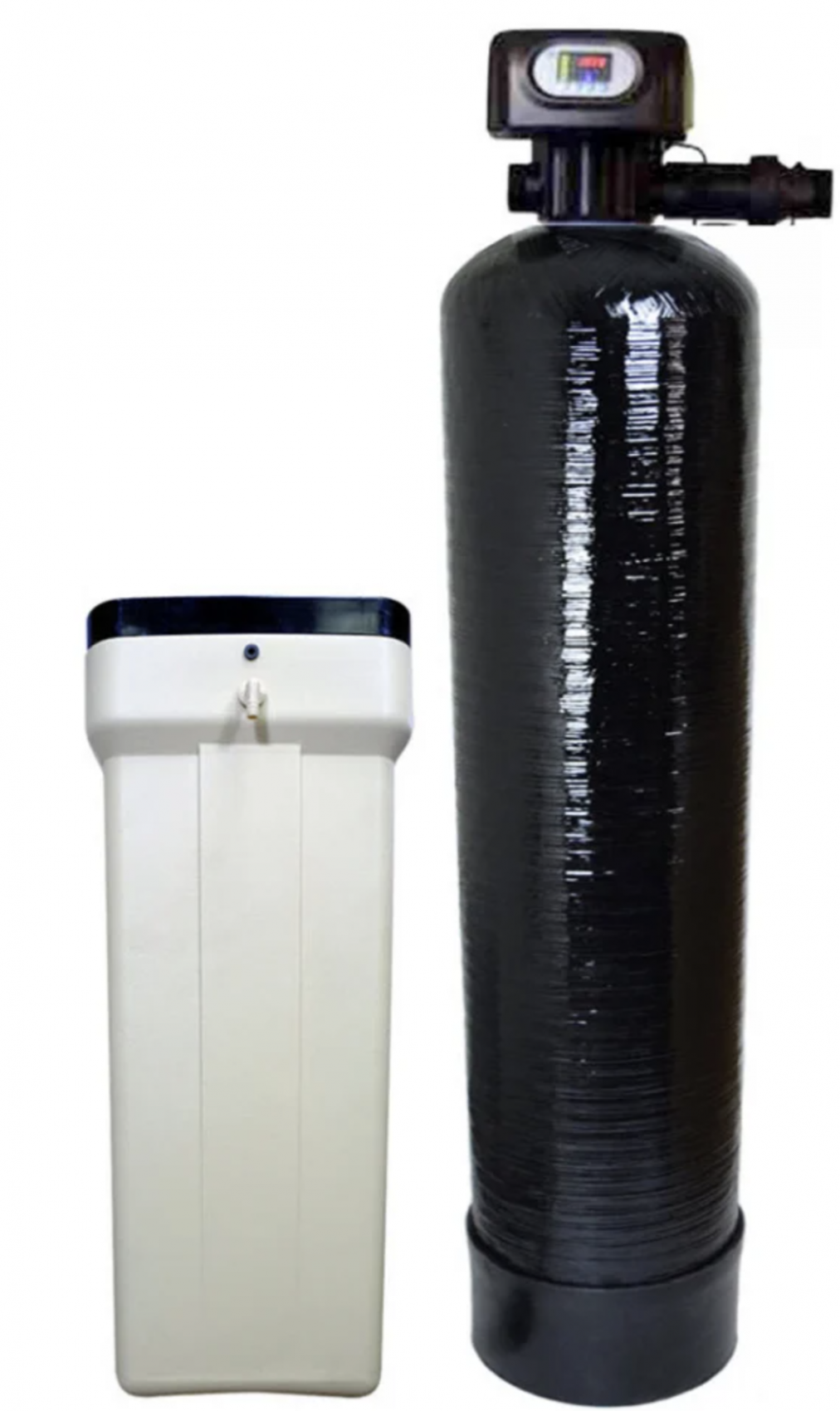
Clean Water Store Commercial Water Softener System Metered On-Demand Saves Salt & Water. Homeowners and businesses like this heavy-duty commercial water softening system for high flow rates, low pressure drop and super long service life. This system is WQA -Certified and uses 8% cross-linked Softener Resin that lasts for many years and is chlorine resistant.
Learn more about drinking water quality from the Environmental Protection Agency.
Who Installs Commercial Systems for Residential Homes?
Many homeowners worry that “commercial” means “complicated installation.” In reality:
-
- Most commercial-size tanks install exactly like standard residential tanks.
- The equipment footprint is often only marginally larger.
- Any plumber or well contractor familiar with residential systems can install them.
- Remote or guided install support is common (and works well for DIY-savvy homeowners).
So while the system is “commercial,” the install experience remains highly manageable.
Frequently Asked Questions about Commercial Size Water Treatment
Q: What’s the sign that a standard residential water system isn’t cutting it?
The most common symptoms are pressure drops when multiple things are running at once — somebody showering while the dishwasher is going and the laundry is on — and you notice the water slowing down or the filtration just not keeping up. High iron or sulfur wells especially can overwhelm a standard residential system pretty quickly. The media gets exhausted faster, the system backwashes more, and you’re never really getting ahead of the problem.
Q: Does running a commercial system in a home wear it out faster?
Actually the opposite. Because the system is sized above what the home needs on a typical day, it’s rarely running at its maximum output. That means less stress on the valve, the control head, all the components. Commercial-grade equipment is built for durability, and when it’s not being pushed to its limits daily, it lasts even longer.
Q: What kind of home actually needs a commercial-size water system?
More homes than people expect. If you have three or more bathrooms, a large family, an accessory dwelling unit, an irrigation line tied into the same treatment system, or a well with serious iron or sulfur — you’re probably a candidate.
The real answer comes from a water test and a peak flow test. Once we see the actual numbers, it becomes pretty clear whether a residential system is going to do the job or whether you need the extra capacity.
Q: Wait — can a water system actually be too big? Is there such a thing as oversizing?
Yes, and this is an important thing to be honest about. Going too big relative to your actual water usage can create its own problems, and it’s one of the reasons we take sizing seriously rather than just always recommending the largest option.
The core issue is backwash frequency. Iron filters — and softeners, for that matter — need to backwash or regenerate regularly to stay effective. That process cleans the media, flushes out accumulated iron and sediment, and recharges the system. When a tank is significantly oversized for a home’s actual flow, it may go too long between cycles. And when backwash cycles are too infrequent, a few things can go wrong.
For iron filters, the media bed can start to pack down and channel, meaning water finds shortcuts through the media rather than passing through it evenly. Iron and manganese can also accumulate in the tank between cycles and eventually start to harden, which shortens media life and reduces performance. For softeners, infrequent regeneration allows iron and minerals to sit on the resin beads long enough to cause fouling that a normal regeneration cycle can’t fully reverse. Over time that permanently reduces the resin’s capacity.
There’s also the issue of stagnant water. A very large tank that isn’t cycling regularly can have water sitting in it for extended periods, which creates conditions you don’t want in a drinking water system.
And from a purely practical standpoint — if someone’s actual flow demand is modest and their iron levels are moderate, putting in the largest tank available wastes money upfront and uses more water per backwash cycle without delivering any additional benefit.
The sweet spot is matching the system to the real data: your water chemistry, your peak flow rate, and your daily usage. That’s why we start with a water test and a flow test. Sometimes that points to a commercial-size system. Sometimes it points to a well-designed mid-range system. The goal is always the right fit, not the biggest fit.
Q: What about irrigation? Does that factor into water treatment sizing?
It does, and it comes up more than people might expect. A lot of homeowners with well water want to treat their irrigation water too — mainly to keep iron staining off their driveways, sidewalks, siding, and landscaping.

That’s actually pretty common with iron filters, since untreated well water running through sprinklers can leave rust stains all over everything. It’s not something you’d typically do with a water softener — you don’t want to be putting softened, sodium-rich water on your lawn and garden — but for iron filtration it makes a lot of sense.
And when you factor irrigation into the equation, that peak flow demand goes up significantly, which is often exactly what pushes a home into commercial-size territory. It’s one more reason the sizing conversation has to account for the whole property, not just the fixtures inside the house.
Bottom Line: Why Might a Commercial-Size System Be the Best Fit for Your Home?
Because for many homeowners, a commercial system delivers:
-
- Stronger performance
- Longer lifespan
- Better water quality
- Fewer headaches
- Lower long-term cost
A properly sized system isn’t about selling bigger equipment, it’s about solving your water problem with equipment that truly matches your home’s needs. While we sell commercial sized systems to residential homes, we only do so when it makes sense for your water and your situation.
Curious if a commercial-size water treatment system is the right upgrade for your residential home? Give our friendly water experts a call, or schedule an appointment by clicking the banner below.


