_2.png)
 Request a Call
How to Stop Rust Stains from Sprinklers for Good (Well Water Guide)
If your sprinklers are leaving orange or brown stains on your fence, driveway, siding, or concrete, you’ve probably already tried scrubbing them off. Maybe more than once. The frustrating truth: cleaning the stains does nothing to prevent new ones. Until you treat the water causing them, the stains will keep coming back — every single watering cycle.
In this guide, Gerry from Clean Water Store walks you through exactly what’s causing those stains and, more importantly, how to stop them permanently. We also cover the two main treatment approaches — polyphosphate injection and iron filtration — so you can choose the right solution for your situation.
Watch: How to Stop Rust Stains from Your Sprinklers for Good
Gerry breaks down the full picture in this short video — why your water looks clear but still stains, how dissolved iron behaves when it hits air, and when each treatment approach makes sense for your irrigation setup:
Keep reading for a deeper dive into everything covered in the video, plus additional detail on sizing, treatment options, and what to do first.
Why Is My Well Water Leaving Rust Stains on Everything?
Here’s the thing most homeowners don’t realize: your water can look perfectly clear coming out of the tap and still be loaded with iron. This is called ferrous iron — dissolved iron that’s invisible in water but oxidizes the moment it’s exposed to air. When your sprinklers spray that water across your fence, concrete, or siding, the iron reacts with oxygen and converts to ferric iron — rust — right on the surface.
That’s why scrubbing doesn’t work. You’re removing the rust that’s already there, but the next watering cycle deposits more. The only fix is treating the water before it hits your sprinklers.
According to Rutgers University Extension, irrigation water with iron levels above just 0.3 ppm can cause rust staining and discoloration on surfaces — a level that’s extremely common in private wells.
Q: My water looks completely clear. How can it have iron in it?
Clear water iron (ferrous iron) is dissolved and invisible until it’s exposed to oxygen. When your well water is under pressure in pipes, the iron stays dissolved. The moment it’s sprayed through a sprinkler — exposed to air — it oxidizes and turns into the orange rust you’re seeing. A simple water test will tell you exactly how much iron is in your water. You can’t tell by looking.

Q: Could the stains be coming from my pipes, not my well water?
Possibly, but less likely if you’re seeing stains primarily on outdoor surfaces hit by sprinkler spray. Pipe corrosion tends to show up as rust-colored water or staining around indoor fixtures. If the staining is concentrated on surfaces your sprinklers hit — fences, siding, walkways — the iron is almost certainly coming from your well water, not your pipes. A water test at the source will confirm it either way. Here’s how to test your well water properly.
Why Is the Irrigation Line the Problem — Even If You Already Have a Water Filter?
This surprises a lot of homeowners. If you already have an iron filter or whole house treatment system installed, you might wonder why your sprinklers are still staining.
The answer: most irrigation lines are plumbed before or around the treatment system. This is done intentionally — treating the large volumes of water used for irrigation through a standard residential iron filter would overload the system, exhaust the media much faster, and require far more frequent backwashing. So the irrigation line bypasses the treatment and gets raw, untreated well water directly.
This means even homeowners with a whole house iron filter can have rust staining problems on their lawn and landscaping — because the outdoor water was never treated to begin with.
Q: Can I just run my irrigation water through my existing whole house iron filter?
In most cases, no — or at least not without consequences. Irrigation systems can move thousands of gallons of water per watering cycle. A residential iron filter sized for household use (typically 8–12 GPM service flow) is not designed to handle that volume continuously. Running irrigation through it would deplete the filter media rapidly and prevent proper backwashing. The better approach is a dedicated irrigation treatment solution — either a polyphosphate injection system or a larger iron filter specifically sized for your irrigation flow rate.
What Are the Two Main Solutions for Irrigation Rust Stains?
There are two fundamentally different approaches. Understanding the difference helps you choose the right one for your situation.
Option 1: Polyphosphate Injection
Polyphosphate injection is a chemical sequestration method. A small dosing pump injects polyphosphate solution into your irrigation line ahead of the sprinklers. The polyphosphate binds to iron molecules and keeps them in solution — so when the water is sprayed, the iron doesn’t precipitate out as rust on contact with air.
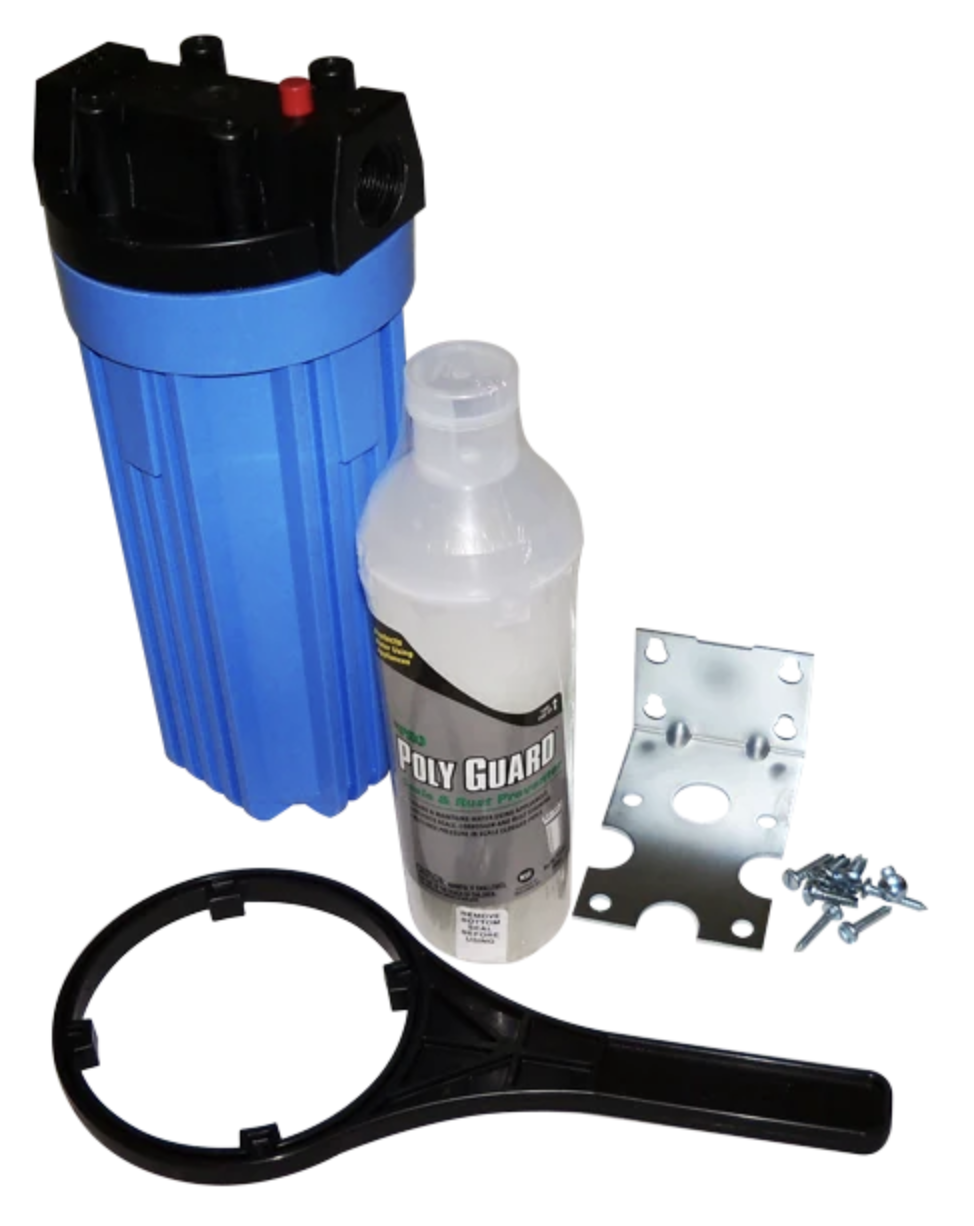
The pros:
-
- Lower upfront cost and simpler installation
- Works well for moderate iron levels
- No large filter tank required
- Good option when irrigation volumes are very high and iron levels are moderate
The limitations:
-
- Does not remove iron from the water — it just keeps it from staining. The iron is still there.
- Ongoing chemical cost — you’re continuously buying and refilling polyphosphate solution
- Can leave a slight residue as water evaporates on very hot days
- Not effective for very high iron levels or iron bacteria
- Does not address iron clogging of drip irrigation emitters
Polyphosphate keeps iron in solution so it doesn’t produce stains — but it’s not perfect, and evaporation can still leave an iron residue in some conditions.
Q: Is polyphosphate safe for plants and lawn?
Yes, polyphosphate is generally considered safe for plants and soil at normal dosing levels. However, overdosing can make water feel slippery and may cause gastrointestinal upset if the water is consumed at high concentrations. Always follow the manufacturer’s dosing guidelines and use a properly sized injection pump calibrated to your water flow.

Option 2: Iron Filtration for Irrigation
An iron filter dedicated to your irrigation line removes the iron from the water before it reaches your sprinklers — permanently and completely. Unlike polyphosphate, there are no ongoing chemicals to buy and no iron left in the water at all.
The key difference from a household iron filter is sizing. Irrigation systems require much higher flow rates — often 20–50 GPM depending on the number of zones — and run for extended periods. An irrigation iron filter must be sized for your peak irrigation flow rate, not your household demand.
The pros:
-
- Permanently removes iron — no staining, no chemicals, no ongoing cost
- Protects drip emitters and sprinkler heads from clogging
- No ongoing chemical purchases
- Better for high iron levels (above 3–5 PPM)
- Also removes manganese and sediment
The considerations:
-
- Higher upfront cost than polyphosphate, especially for large irrigation systems
- Requires proper sizing to your irrigation flow rate — undersizing leads to poor performance
- Needs a backwash cycle, which must be scheduled when irrigation is not running
Q: Can an iron filter handle the flow rate my irrigation system needs?
Yes — but sizing is critical. Residential irrigation systems vary widely in flow demand. To size correctly, you need to know your peak irrigation flow rate in GPM (typically measured at the irrigation valve or controller) and your iron level from a water test. With those two numbers, our water specialists can size the right system for your setup.
Polyphosphate vs Iron Filter: Which Is Right for Your Irrigation Setup?
| Polyphosphate Injection | Iron Filter | |
|---|---|---|
| Removes iron? | No — sequesters it | Yes — fully removed |
| Stops staining? | Mostly — may leave slight residue | Yes — completely |
| Ongoing cost? | Yes — chemical refills | Minimal — occasional media replacement |
| Best for iron level | Moderate (<3 PPM) | Any level |
| Iron bacteria? | Not effective | With chlorination upstream |
| Protects drip emitters? | Partially | Yes |
| Upfront cost | Lower | Higher |
| Long-term cost | Higher (ongoing chemicals) | Lower |
Bottom line: polyphosphate is a practical short-term or budget solution for moderate iron. An iron filter is the permanent fix — especially for higher iron levels, iron bacteria, or drip irrigation systems where clogging is a concern.
What About Iron Bacteria in Irrigation Water?
Iron bacteria are a separate problem from dissolved iron — and a more difficult one. These microorganisms feed on iron and form a reddish-brown slime in toilet tanks, around irrigation fittings, and inside pipes. If you’re seeing slimy orange or brown buildup (not just staining) in your irrigation system, iron bacteria may be involved.

Iron bacteria are not effectively treated by polyphosphate or a standard iron filter alone. They require chlorination upstream — typically a chlorine injection system — to kill the bacteria before the water reaches the filter.
Q: How do I know if I have iron bacteria vs just dissolved iron?
The clearest sign of iron bacteria is slimy, gelatinous buildup — often described as looking like orange or reddish-brown snot — inside toilet tanks, around sprinkler heads, or in the irrigation line itself. Dissolved iron alone causes staining but not slime. A water test that includes iron bacteria testing will confirm which you’re dealing with. Call our team and we can help you interpret your results.
How to Size an Iron Filter for Irrigation
Sizing an irrigation iron filter is different from sizing a household system. Here’s what you need to know:
Step 1: Measure your irrigation flow rate in GPM. Run your irrigation system and measure the flow at the main irrigation valve using a flow meter or a bucket test. Irrigation systems commonly run at 15–50 GPM depending on the number of zones running simultaneously.
Step 2: Know your iron level. Get a water test that includes iron (ferrous and ferric), manganese, pH, and iron bacteria. Iron level determines the media type and tank size required.

Step 3: Consider your backwash window. An irrigation iron filter needs a backwash cycle — typically 10–15 minutes — when irrigation is not running. This usually means scheduling backwash at night or early morning before the irrigation controller starts.
Step 4: Match tank size to flow rate. Unlike household filters sized for 8–12 GPM, irrigation filters often need to handle 20–50 GPM. This means larger tank diameters to provide adequate media contact time and sufficient backwash flow. Our water specialists size irrigation systems every day — call or chat with us and we’ll build the right spec for your setup.
What Should I Do First?
Test your water. You cannot choose the right solution without knowing your iron level, iron type, pH, and whether iron bacteria are present. A water test also tells you whether polyphosphate is likely to be sufficient or whether filtration is the better investment for your situation.
At Clean Water Store, our WQA certified water specialists review water test results and help homeowners design the right irrigation treatment system for their specific water chemistry and flow requirements. We’ve been solving iron staining problems for well water customers since 1986.
Order a Water Test Kit — Start Here
View Pro-OX Iron Filter Systems
Complete Guide: How to Remove Iron, Manganese & Odor from Well Water

Article last updated by Author on May 26, 2026.
Helpful Resources
Management of Iron in Irrigation Water — Rutgers University Extension
Iron and Manganese in Private Water Systems — Penn State Extension
Iron and Manganese in Drinking Water — University of Nebraska Extension
Interpreting Irrigation Water Tests — Penn State Extension
Iron Bacteria in Well Water — Minnesota Department of Health
Iron and Sulfur Bacteria: A Slimy Problem — Penn State Extension


