_2.png)
 Request a Call
Does Chlorine in Your Shower Water Affect Your Skin and Hair?

Last updated: June 16, 2026
Does Chlorine in Your Shower Water Affect Your Skin and Hair?
If your skin feels tight after a shower, your hair seems dull no matter what products you use, or your scalp itches more than it should, your city water may be part of the problem.
Chlorine is added to municipal water supplies to kill bacteria and keep water safe as it travels through miles of pipes to your home. That’s a good thing. But by the time it reaches your showerhead, that same chlorine can affect your skin and hair in ways that are easy to mistake for a product issue, a diet issue, or just aging.
In summer, the problem gets worse. Hot showers open pores and soften hair cuticles, making both more susceptible to chlorine absorption. And if your city uses chloramine — a longer-lasting disinfectant increasingly common in municipal water — the effects are slower to notice but more persistent than free chlorine.
Here’s what the research says, what to look for, and what actually helps. For a broader look at how chlorine affects skin beyond the shower, see our comprehensive guide to chlorine skin effects.
What Is Chlorine Doing in Your City Water?
Municipal water systems add chlorine or chloramine to disinfect drinking water and prevent bacterial growth in the distribution system. This is tightly regulated and essential for public health — without disinfection, waterborne illness would be far more common.
The EPA sets a maximum residual disinfectant level of 4 milligrams per liter for chlorine in tap water, which is considered safe for drinking. But safe to drink and ideal for daily skin and hair contact are two different things — especially when you factor in hot showers, where chlorine vaporizes and can be inhaled as well as absorbed through the skin.
Chlorine vs. chloramine — what’s the difference?
Many cities have shifted from free chlorine to chloramine (a combination of chlorine and ammonia) because it lasts longer in the distribution system and produces fewer disinfection byproducts in drinking water. For skin and hair, however, chloramine presents its own challenges. Unlike free chlorine, chloramine does not evaporate out of water on its own — and research published in the Journal of Allergy and Clinical Immunology found that chloramine exposure is associated with increased skin permeability, meaning it actually makes your skin less effective at keeping irritants out.
If you’re not sure whether your city uses chlorine or chloramine, check your annual Consumer Confidence Report (CCR). Our WQA certified specialists can also help you read it. Learn how to read your city water quality report here.
For a full overview of chlorine in city water and how to remove it, see our dedicated guide: What You Should Know About Chlorine in City Water.
What Chlorine Does to Your Skin
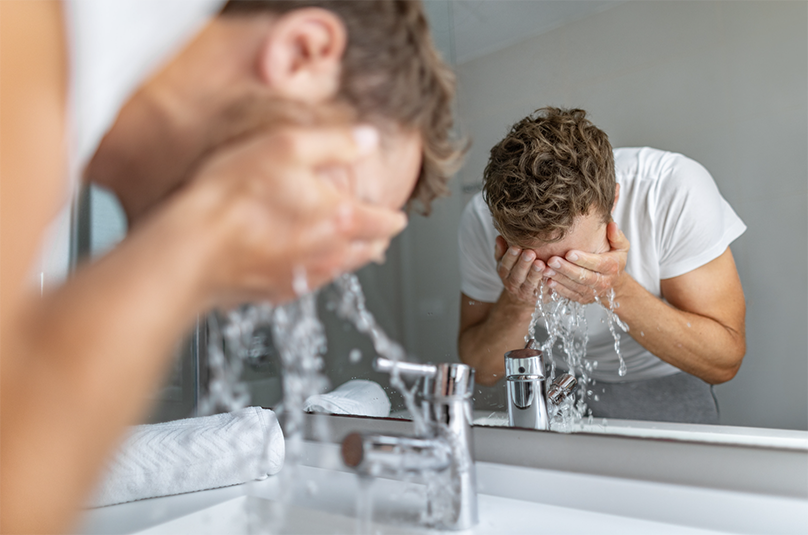
Your skin has a natural protective barrier made up of oils and beneficial bacteria. Chlorine is an oxidizer — it doesn’t discriminate between the bacteria in your pipes and the protective oils on your skin. Daily shower exposure strips those oils, which leads to a cascade of effects most people attribute to other causes.
-
- Dryness and tightness. Chlorine increases transepidermal water loss (TEWL) — meaning skin literally holds onto moisture less effectively after exposure. If your skin feels tight after every shower, this may be why.
- Sensitivity and irritation. Stripped skin barrier means more exposure to environmental irritants. People with naturally sensitive skin notice this more acutely.
- Eczema flare-ups. Research has directly linked domestic water chlorine to eczema development and skin barrier impairment. For children especially, daily bath and shower exposure is worth discussing with a dermatologist if eczema is a recurring issue.
- Premature aging. Chronic oxidative stress from daily chlorine contact may contribute to collagen and elastin breakdown over time.
When hard water minerals are present alongside chlorine, the effects compound — minerals deposit on skin reducing moisture absorption while chlorine strips the oils that would otherwise protect against that buildup. Read more about the combined effects of chlorine and hard water on skin.
Why summer makes it worse
Hot showers open your pores, increasing the rate at which skin absorbs chlorine. Steam also vaporizes chlorine and its byproducts — including trihalomethanes (THMs), some of which are classified as potential carcinogens — creating inhalation exposure in an enclosed shower or bath. In summer, when people shower more frequently, the cumulative daily exposure adds up faster.
What Chlorine Does to Your Hair
Hair is made of keratin proteins covered by a cuticle layer that, when healthy, lies flat and reflects light — which is why healthy hair looks shiny. Chlorine oxidizes keratin and roughens the cuticle, producing the dullness, frizz, and breakage that most people attribute to heat styling, product buildup, or hard water minerals.
-
- Dullness and loss of shine. Damaged cuticles scatter light instead of reflecting it. No amount of conditioning product fully compensates for this because the damage is structural, not cosmetic.
- Frizz. Chlorine strips natural oils from the hair shaft, making hair more susceptible to humidity — the primary driver of frizz.
- Breakage and split ends. Weakened keratin proteins make hair more brittle and prone to breaking, particularly in hair that is already heat-styled or chemically processed.
- Color fading. For color-treated hair, chlorine accelerates fading by oxidizing the dye molecules. Shower chlorine is less concentrated than a swimming pool but the daily cumulative exposure is significant.
- Scalp irritation. The same stripping effect that dries skin can irritate the scalp, contributing to itching and flaking that is often mistaken for dandruff.
If you’re also dealing with hard water, the combination of minerals and chlorine is particularly hard on hair. See our guide on carbon filters vs. water softeners for dry hair to understand which solution fits your situation.
How Do You Know If City Water Is Affecting Your Skin or Hair?
The tricky part is that chlorine damage accumulates gradually. Most people don’t notice it until they travel somewhere with different water — or install a filter — and realize how different their skin and hair feel within a week or two. While a shower filter could be a quick fix for a rental, whole house water filters offer stronger and longer lasting water filtration for homeowners.
Here are some signs city water chlorine may be a contributing factor:
-
- Skin feels dry or tight after showering, even immediately after applying moisturizer
- Hair looks dull, feels rough, or frizzes more than it used to
- Eczema or skin sensitivity flares up more in summer
- Color-treated hair fades faster than your colorist expects
- Scalp feels itchy or irritated without another obvious cause
- You can smell chlorine in the shower — a sign of higher-than-average concentrations
A simple at-home water test can confirm your chlorine levels. Browse our water testing options here — from easy at-home strips to a certified lab test.
What Actually Helps: Whole House Carbon Filtration
The most effective long-term solution for city water homes is a whole house carbon backwash filter installed at the point of entry — where water enters your home. This treats every tap, every shower, and every appliance with filtered water, so you’re not managing the problem one showerhead at a time.
Activated carbon is the most proven technology for chlorine and chloramine removal. It works by adsorption — chlorine and its byproducts bond to the carbon surface as water passes through the media. A quality backwash carbon filter regenerates itself automatically, flushing accumulated contaminants down the drain, which means the media lasts for years without manual intervention.
Whole house filter vs. shower filter — what’s the difference?
| Factor | Shower filter | Whole house carbon filter |
|---|---|---|
| Coverage | One shower only | Every tap, shower, bath, and appliance |
| Chloramine removal | Varies — many shower filters do not remove chloramine | Yes, with catalytic carbon media |
| Maintenance | Cartridge replacement every 3 to 6 months | Automatic backwash; media lasts years |
| Protects pets and kids | No | Yes — every tap in the home |
| Upfront cost | Low | Higher upfront, lower long-term cost |
| Long-term value | Ongoing cartridge costs add up | Most cost-effective solution for whole home |
Shower filters are a reasonable short-term solution, but they have real limitations — particularly for chloramine removal, which requires catalytic carbon rather than the standard KDF or basic carbon found in most shower filters. If your city uses chloramine and you’re using a standard shower filter, you may not be getting the protection you think you are.
A whole house carbon backwash filter with catalytic carbon media handles both free chlorine and chloramine, protects every outlet in the home, and requires minimal ongoing maintenance.

If your water test shows both chlorine and hard water, a carbon filter paired with a softener or salt-free conditioner addresses both together. See our whole house city water bundles here.
Other City Water Contaminants That Affect Skin and Hair
Chlorine gets most of the attention, but it’s not the only city water contaminant worth knowing about:
-
- Hard water minerals (calcium and magnesium). Hard water leaves a mineral film on skin and hair that prevents moisture absorption and contributes to buildup. If you have both chlorine and hard water, addressing both together gives the best results.
- Disinfection byproducts (THMs and HAAs). Chlorine reacts with natural organic matter in water to form trihalomethanes and haloacetic acids. These are regulated in drinking water but carbon filtration reduces them significantly.
- PFAS. Increasingly detected in city water supplies, PFAS are not removed by standard carbon filters — they require NSF-certified PFAS-specific media. Read our PFAS treatment guide here.
Frequently Asked Questions
Can chlorine in shower water cause hair loss?
Chlorine alone is not a documented cause of hair loss, but it can cause breakage that mimics thinning — particularly in hair that is already chemically processed, heat-styled, or naturally fine. If you’re experiencing significant hair loss rather than breakage, speak with a dermatologist as this is more likely to have a medical or nutritional cause.
How do I know if my city uses chlorine or chloramine?
Check your annual Consumer Confidence Report (CCR) — your water utility is required to publish this every year and it will specify which disinfectant is used. Learn how to find and read your CCR here. You can also contact our team and we’ll help you interpret it.
Does a standard shower filter remove chloramine?
Most standard shower filters use KDF media or basic carbon, which are effective for free chlorine but not chloramine. Chloramine requires catalytic carbon to break down effectively. If your city uses chloramine, a whole house catalytic carbon filter handles it at the point of entry for every outlet in your home.
How quickly will I notice a difference after installing a whole house filter?
Most people notice a difference in water taste and smell immediately. Skin and hair changes typically become noticeable within two to four weeks of consistent filtered water use — enough time for skin barrier function to partially recover and hair to show reduced frizz and improved moisture retention.
Does hard water make chlorine damage worse?
Yes. Hard water and chlorine together create a compounding effect. Read our full guide on the combined effects of chlorine and hard water on skin.
Is filtered water safe for my pets too?
Yes — filtered water benefits pets for the same reasons it benefits people. Chlorine and chloramine in tap water can irritate a dog’s digestive system and contribute to skin sensitivity, particularly in summer when pets are bathed more frequently. Read our guide on water safety for pets here.
Ready to Test Your City Water?
If you’re not sure what’s in your water, the best first step is a test. We offer easy at-home kits, our General Mineral Analysis for $39, and certified lab testing through our partners. Our WQA certified specialists can review your test results or take a look at your city’s free report and recommend the right solution — whether that’s a whole house carbon filter, a softener, or a combination system.
Whatever you decide, understanding your water is the first step to improving it.
Contact our team Monday through Friday, 7:30 AM to 3:30 PM PT at support@cleanwaterstore.com.

Related resources
Understanding Chlorine Skin Effects: A Comprehensive Guide
Effects of Chlorine and Hard Water on Skin
What You Should Know About Chlorine in City Water
Is City Water Safe to Drink? How to Read Your Local Water Quality Report
Pet Hydration: What to Know About Water Safety
What are PFAS? Are They in My Water?
Whole House Filtration and Softening Bundles for City Water
12 Reasons to Use a Salt-less Water Conditioner
Government references
Overview of Drinking Water Treatment Technologies — U.S. EPA
Disinfection Byproducts in Drinking Water — U.S. EPA


